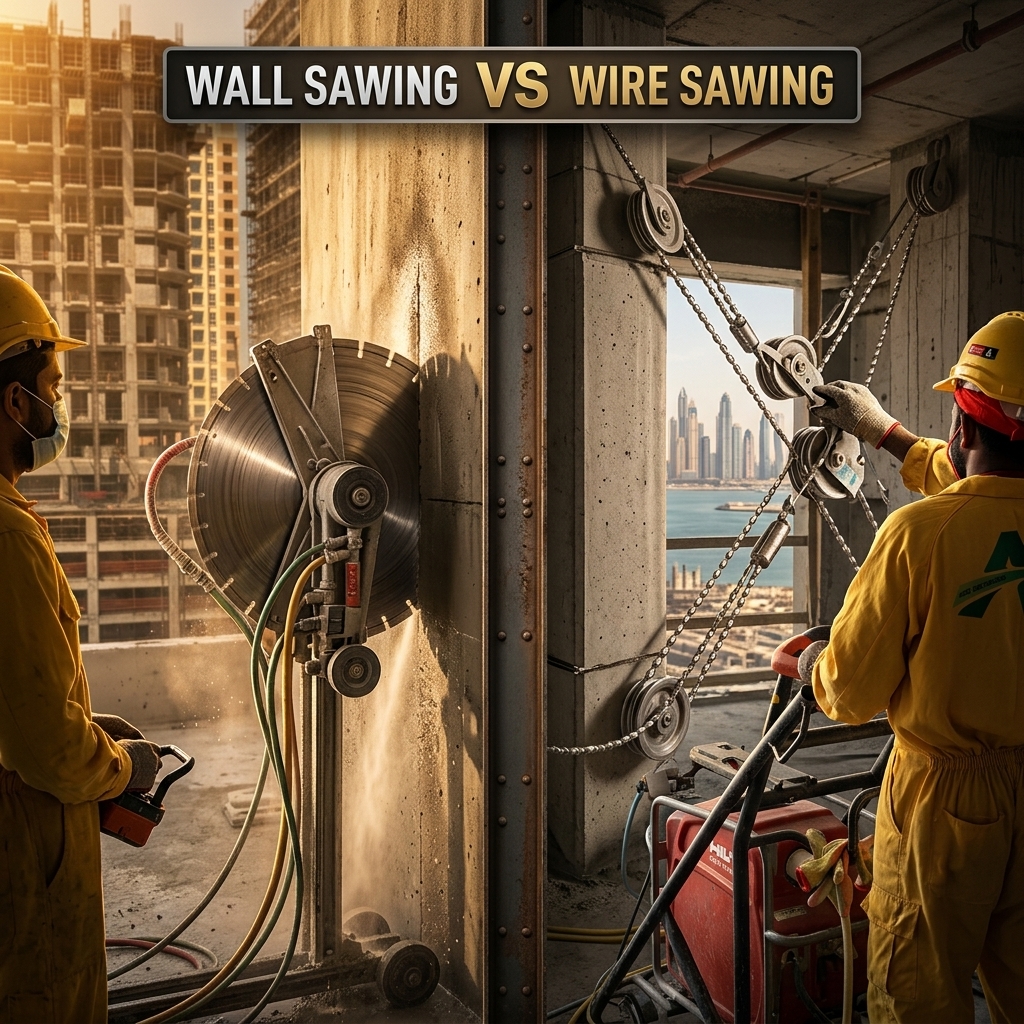
When a Qatar construction project requires large, precise cuts through concrete walls, slabs, or thick structural elements, two specialist methods dominate: wall sawing and wire sawing. Both use diamond cutting technology, both produce clean results with minimal vibration, and both are essential tools in the specialist concrete cutting contractor's arsenal. However, they serve different purposes, work best in different conditions, and carry different cost and scheduling implications.
Understanding the differences between these two methods helps project managers, engineers, and procurement teams make better decisions when specifying concrete cutting work. In this guide, we break down both techniques and provide practical guidance on which to choose for your Qatar project.
Wall Sawing Explained
Wall sawing, also known as track sawing, uses a diamond-tipped circular blade mounted on a track-guided carriage that runs along the surface being cut. The track is bolted to the concrete surface, and the saw travels along it while the blade cuts into the material at a controlled depth. Electric or hydraulic motors power the blade, and water is used for cooling and dust suppression.
How It Works
The operator first drills anchor holes and fixes a straight aluminium or steel track to the wall or floor surface. The saw unit is mounted onto the track and connected to its power source. The blade is then advanced into the concrete incrementally, making multiple passes at increasing depth until the full thickness is cut. Blades are available in diameters from 400 mm to over 1,600 mm, allowing cut depths from approximately 150 mm to over 730 mm in a single pass from one side.
Capabilities and Best Uses
- Maximum depth: Up to approximately 730 mm from one side, or the full thickness of a wall when cut from both sides.
- Cut precision: Extremely precise straight cuts with tolerances of a few millimetres, producing smooth, clean edges that require minimal finishing.
- Applications: Door and window openings, ventilation shafts, lift shaft modifications, service risers, structural alterations, and any project requiring straight-line cuts through walls or slabs.
- Environment: Well-suited to indoor environments where controlled, low-vibration cutting is needed. Widely used in occupied buildings, hospitals, and commercial spaces.
Wire Sawing Explained
Wire sawing uses a continuous loop of diamond-impregnated wire (or cable) that is threaded around the structure to be cut and driven by a hydraulic or electric flywheel. The wire passes through a series of pulleys positioned to guide the cut path, and the flywheel pulls the wire through the concrete at high speed. Like wall sawing, water cooling is essential to manage heat and flush cutting debris.
How It Works
The operator drills one or more access holes through the structure at the corners or endpoints of the intended cut line. The diamond wire is threaded through these holes and around guide pulleys, forming a continuous loop. The wire saw drive unit tensions the wire and rotates it at speed, pulling it through the concrete. As the wire cuts, the drive unit adjusts tension automatically to maintain optimal cutting pressure. The process continues until the cut is complete.
Capabilities and Best Uses
- Maximum depth: Virtually unlimited. Wire sawing can cut through structures of any thickness, including massive foundations, bridge piers, and dam walls.
- Cut flexibility: Can follow curved, angled, and irregular cut paths that are impossible with a circular blade. Can also cut flush against surfaces where blade overcut would be problematic.
- Applications: Demolition of thick structural elements, bridge deck removal, underwater cutting, removal of large concrete masses, cutting through steel-reinforced structures, and any situation where the structure exceeds wall saw blade capacity.
- Environment: Ideal for outdoor, industrial, and heavy civil engineering applications. Also used in confined spaces where a large wall saw cannot be positioned.
Side-by-Side Comparison
| Factor | Wall Sawing | Wire Sawing |
|---|---|---|
| Maximum Depth | Up to ~730 mm (one side) | Virtually unlimited |
| Cut Shape | Straight lines only | Straight, curved, irregular |
| Precision | Very high (mm tolerance) | High |
| Speed | Fast for standard cuts | Slower setup, steady cutting |
| Cost | Lower for standard openings | Higher (specialised equipment) |
| Noise Level | Moderate | Lower |
| Dust Generation | Low (with water) | Low (with water) |
| Setup Time | Quick (track mounting) | Longer (access holes, pulleys) |
| Overcut | Yes (blade radius at corners) | No overcut |
When to Choose Wall Sawing
Wall sawing is the right choice for the majority of concrete cutting tasks on Qatar construction projects. Choose wall sawing when:
- Creating standard openings: Door openings, window openings, and rectangular penetrations through walls and slabs up to 730 mm thick are the natural domain of wall sawing.
- Working indoors: The compact equipment footprint and precise track guidance make wall sawing ideal for interior work in occupied or partially occupied buildings.
- Precision is critical: When the finished opening must meet tight dimensional tolerances with clean, straight edges, wall sawing delivers the best results.
- Budget is a factor: For standard-sized openings, wall sawing is more cost-effective than wire sawing due to simpler setup and faster cutting speeds.
- Speed matters: Wall sawing setup is faster, and cutting rates through standard concrete thicknesses are typically higher than wire sawing.
When to Choose Wire Sawing
Wire sawing becomes the method of choice when project conditions exceed the physical limitations of a circular blade. Choose wire sawing when:
- Cutting thick structures: Foundations, piers, abutments, and any element thicker than approximately 730 mm require wire sawing. Structures several metres thick can be cut with this method.
- Irregular shapes are needed: Curved cuts, non-linear profiles, and flush cuts without overcut at corners are only possible with wire sawing.
- Underwater cutting: Marine structures, submerged foundations, and elements below the water table can be cut with diamond wire systems.
- Confined spaces: When there is insufficient room to mount a wall saw track and blade, the compact wire saw pulleys can often be positioned in tight areas.
- Heavy demolition: Removing large concrete masses as part of controlled demolition programmes, where the structure needs to be cut into manageable sections for crane removal.
Cost Considerations in Qatar
In Qatar's construction market, wall sawing is generally the more economical option for routine concrete cutting work. The equipment is widely available, setup is relatively quick, and operators can complete standard openings efficiently. Wire sawing involves more specialised equipment, longer setup times, and consumable diamond wire that is more expensive per metre of cut than circular blade segments.
However, cost should not be the only factor. Choosing wall sawing for a job that genuinely requires wire sawing often results in delays, failed attempts, and ultimately higher total costs when the work has to be re-done with the correct method. Similarly, specifying wire sawing for simple openings that a wall saw could handle quickly is an unnecessary expense.
The most cost-effective approach is to discuss your project requirements with a specialist contractor who can assess the structure, understand the constraints, and recommend the right method. For projects that require multiple types of cuts, a combination of core drilling, wall sawing, and floor sawing may provide the best overall value.
Aseel's Recommendation
At Aseel Constructions, we assess every project individually. Our recommendation is always based on what will deliver the best result for the specific structure, access conditions, timeline, and budget. For most building modification projects in Qatar, wall sawing handles the majority of cutting work effectively. We reserve wire sawing for situations where it is genuinely the only practical option, such as cutting through thick foundations or creating curved openings.
Our team is equipped for both methods and can advise you on the most appropriate approach during the quotation stage. We also combine cutting methods with concrete coring and GPR scanning to deliver complete solutions for structural modification projects.
Need Expert Concrete Cutting in Qatar?
Whether your project needs wall sawing, wire sawing, or a combination of methods, Aseel Constructions has the equipment, experience, and expertise to deliver precise results. Contact us to discuss your project requirements and receive a detailed quotation.
Get a Free Quote