Chemical & Mechanical Anchoring Services in Qatar
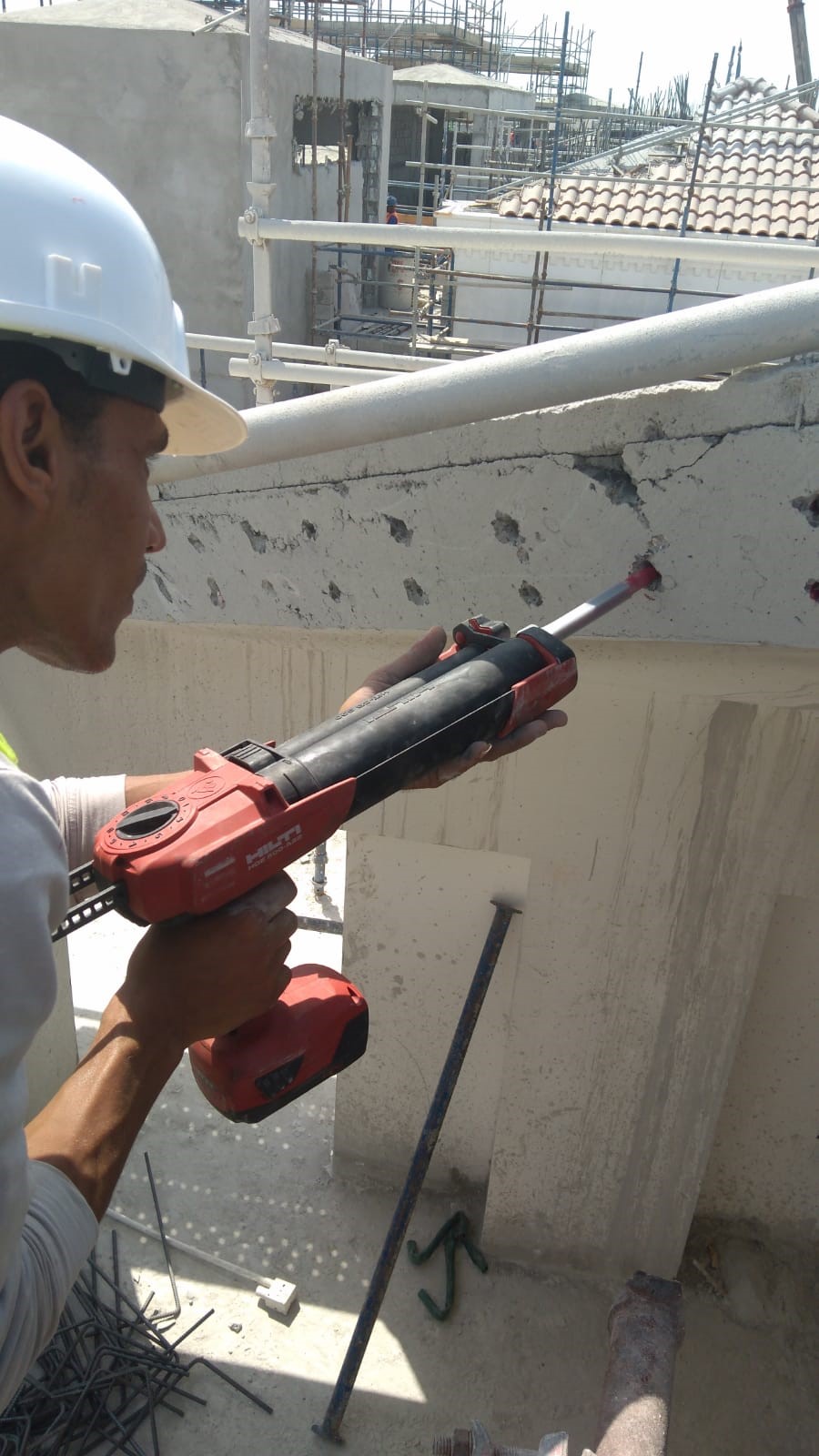
Aseel Constructions delivers professional chemical and mechanical anchoring in Qatar for structural connections, rebar doweling, equipment fixing, and retrofit reinforcement projects. Our installations follow HILTI specifications and industry best practices to ensure every anchor meets the required load capacity and safety standards. Since 2016, we have completed thousands of anchoring installations across Doha and Qatar for building extensions, structural strengthening, facade support, and industrial equipment mounting. We use premium epoxy and chemical adhesive systems for high-load applications and proven mechanical anchor systems for rapid-installation requirements. Every installation begins with proper hole preparation - diamond-drilled, cleaned, and inspected - followed by precise adhesive injection or mechanical setting. Our team can also perform pull-out testing to verify installed anchor performance. Whether your project requires rebar fixing for a concrete extension or heavy-duty base plate anchoring, our experienced installers deliver reliable, specification-compliant results.
How Anchoring Works
Assessment & Specification
We review the structural drawings and anchor design requirements, confirming anchor type, size, embedment depth, edge distances, and spacing per HILTI or engineer specifications.
Diamond Drilling
Holes are drilled to the specified diameter and depth using diamond core drills. Precise hole geometry is critical for proper anchor performance, especially with chemical systems.
Hole Cleaning
Drilled holes are cleaned thoroughly using compressed air and wire brushes to remove dust and debris. Proper cleaning is essential for adhesive bond strength in chemical anchoring.
Anchor Installation
For chemical anchors, resin is injected and the bar is inserted with rotation to ensure full encapsulation. For mechanical anchors, the anchor is inserted and torqued to the specified value.
Curing & Testing
Chemical anchors are allowed to cure per manufacturer specifications. Pull-out testing can be performed on sample anchors to verify load capacity meets design requirements.
Common Applications
Rebar Doweling for Extensions
Installing rebar into existing concrete to create structural connections for building extensions, additional floors, and new slabs tied to existing structures.
Structural Connections
High-strength anchor installations for connecting new structural elements - beams, columns, and walls - to existing concrete frameworks.
Equipment Base Plate Anchoring
Securing heavy machinery, generators, pumps, and industrial equipment to concrete foundations using mechanical or chemical anchor systems.
Facade Support Fixing
Installing anchor points for cladding systems, curtain walls, signage brackets, and external facade support structures on building exteriors.
Handrail Installations
Anchoring handrail posts, balustrade supports, and safety barriers into concrete floors, walls, and parapets for compliance with safety codes.
Retrofit Reinforcement
Adding reinforcement to existing structures through rebar doweling and structural anchor installations for seismic upgrading and load capacity enhancement.
Our Equipment & Capabilities
| Specification | Details |
|---|---|
| Installation Standards | HILTI-specification installations with approved systems |
| Chemical Systems | Epoxy, vinyl ester, and hybrid adhesive anchoring |
| Mechanical Systems | Wedge, sleeve, undercut, and through-bolt anchors |
| Rebar Doweling | 8mm to 32mm rebar with chemical bonding |
| Testing | Pull-out testing with calibrated hydraulic equipment |
| Applications | Structural connections, retrofit, equipment fixing |
| Documentation | Installation records, test reports, and compliance certificates |
Safety & Compliance
All anchoring installations by Aseel Constructions follow strict quality control procedures and comply with Qatar's construction regulations. Our installers are trained in HILTI anchor installation methods and understand the critical importance of proper hole preparation, adhesive mixing, and installation technique. We use only approved adhesive systems within their shelf life, follow manufacturer-specified cure times, and can provide pull-out test documentation to verify anchor performance. Every installation includes GPR scanning when required to avoid existing reinforcement, and all work is documented with installation records for quality assurance traceability.
Frequently Asked Questions
Chemical anchoring bonds the fastener to concrete using injected resin or epoxy. The adhesive fills the gap completely, giving excellent pull-out resistance even close to slab edges where expansion anchors would split the concrete. Mechanical anchoring locks in through friction or wedging action when you torque the bolt.
Mechanical anchors are faster - no cure time, load immediately. Chemical anchors need time but outperform in edge-distance-critical and high-load structural connections. We specify based on your engineer's design, not convenience.
Yes. Every installation follows HILTI-approved procedures: correct hole diameter per anchor size, minimum embedment depth per the design load, specified edge distances, and proper hole cleaning - compressed air and wire brush before resin injection.
Skipping the hole cleaning step is the most common cause of chemical anchor failure in the field. We don't skip it. Installation records and pull-out test documentation are available where required by the project QA plan.
Yes. We carry out proof load pull-out tests using calibrated hydraulic equipment. Each test applies a specified tensile load - typically a defined percentage of the design load per the structural engineer's requirement - and holds it for a set duration. Pass or fail is documented with the applied load, measured displacement, and anchor identification.
For critical installations, we test a sample percentage of the total quantity. Test results form part of the project's quality records.
We install threaded rods from M8 through M30, rebar from 8mm to 32mm diameter, headed bolts, and specialty fasteners for facade brackets and structural steel connections. Chemical systems include hybrid vinyl ester resin for cracked-concrete applications, standard epoxy for high-load rebar doweling, and fast-cure formulations for tight schedules.
The selection always follows the engineer's specification or HILTI design software output. We don't substitute products without approval.
At 20 to 25 degrees Celsius, standard epoxy systems reach working strength in 4 to 6 hours and full cure within 24 hours. Qatar's outdoor summer temperatures - commonly 40 to 47 degrees Celsius - can cut that to 1 to 2 hours for working strength. Short gel times at high temperatures mean the bar must be seated before the resin kicks.
We carry temperature-rated products and select the right system based on your site conditions and the structural team's loading schedule.