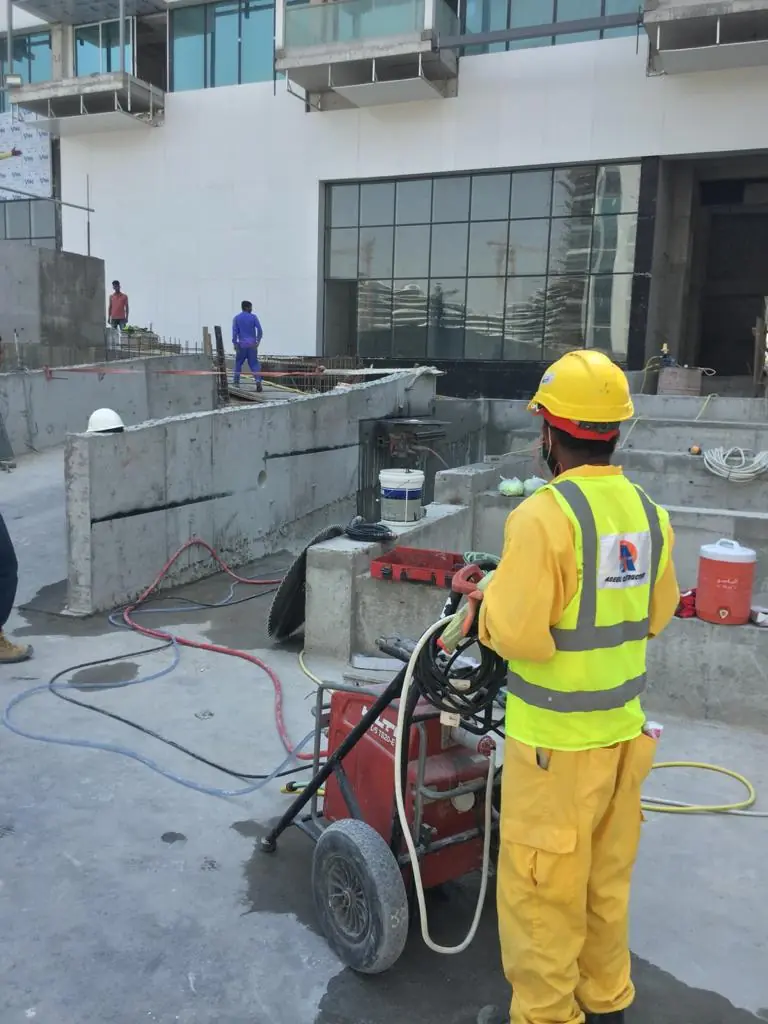
Concrete cutting is essential for modern construction, but it carries real hazards. This guide covers OSHA standards, PPE requirements, dust control, and practical safety measures used across Qatar's most demanding projects.
What is concrete cutting and why is safety critical?
Concrete cutting refers to the controlled removal of concrete using specialized equipment like wall saws, core drills, and floor saws. The process appears straightforward but involves significant occupational hazards. Concrete dust contains crystalline silica, which causes silicosis, a permanent lung disease affecting workers exposed to airborne particles. A single shift of unprotected cutting can expose workers to silica concentrations 10-50 times above OSHA's permissible exposure limit of 50 micrograms per cubic meter over an 8-hour shift.
Beyond dust, operators face noise exposure (wall saws produce 95-110 decibels), vibration injuries, eye damage from flying debris, and thermal stress in Qatar's climate. Regulations exist because these injuries accumulate silently. Silicosis takes years to develop but causes irreversible lung scarring.
What are the main hazards in concrete cutting operations?
Silica dust exposure: Crystalline silica is released when sawing dry concrete. The International Labour Organization estimates silica exposure causes 67,000 deaths annually worldwide. In Qatar's hot climate, dry cutting is tempting to avoid water cleanup, but it dramatically increases exposure. A worker cutting concrete dry for 8 hours can inhale the equivalent of annual exposure limits in a single shift.
Noise-induced hearing loss: Concrete saws operate at 95-110 decibels. OSHA requires hearing protection at 85 dB and above. Eight hours of exposure at 100 dB causes permanent hearing damage in most people. Qatar's outdoor heat drives workers toward earplugs alone, which provide only 15-30 dB reduction depending on insertion depth.
Vibration white finger: Handheld cutting tools cause vibration-induced white finger (VWF), a circulatory condition reducing blood flow to fingers. Symptoms include numbness and loss of dexterity. Long-term exposure causes permanent damage irreversible even after equipment use stops.
Eye and skin injuries: Concrete chips, water spray, and abrasive dust damage eyes and exposed skin. Qatar's intense UV combined with equipment spray increases risk. A single chip at velocity can cause corneal abrasion requiring medical attention.
Thermal stress: Qatar's ambient temperature reaches 50°C+ by July. Heavy PPE, equipment operation, and physical exertion combine to cause heat exhaustion. Workers wearing respirators and protective clothing in peak heat face internal body temperatures reaching 39-40°C within hours.
What PPE is required for concrete cutting?
Respiratory protection: OSHA requires respiratory protection when silica exposure exceeds the PEL. For concrete cutting, this means a minimum N95 mask. N95 provides 95% filtration of particles 0.3 microns and larger. However, N95 masks work only with proper fit testing and seal verification; ill-fitting masks reduce effectiveness to 50% or lower. For extended exposure, powered air-purifying respirators (PAPRs) are superior to N95 and reduce heat stress by providing cooled air. Qatar contractors using N95 should conduct fit tests quarterly and replace masks that lose seal.
Eye protection: Impact-resistant safety glasses (ANSI Z87.1 rated) are minimum. For high-speed cutting, sealed goggles prevent chips and dust from entering from the sides. Polycarbonate lenses resist scratching and impacts better than standard glass.
Hearing protection: Double hearing protection (foam earplugs properly inserted plus over-ear earmuffs) achieves 30-35 dB noise reduction rating (NRR). Properly inserted foam earplugs (rolled, held 10 seconds for expansion) provide NRR 28-33. Combined with earmuffs (NRR 20-25), this meets OSHA requirements for 100 dB environments.
Hand and skin protection: Cut-resistant gloves (Level 3 or higher ANSI rating) protect against sharp concrete chips. Nitrile gloves underneath prevent moisture buildup in Qatar's heat. Full-length sleeves and pants are required, with reinforced areas over high-wear zones. Sunscreen SPF 50+ protects skin during extended outdoor work in direct sun.
Foot protection: Steel-toed boots with puncture-resistant soles prevent injuries from falling equipment or sharp concrete fragments. Slip-resistant soles are critical around wet cutting areas.
How should water cooling be managed for dust control?
Wet cutting (using water spray on the blade) reduces silica dust by 95% compared to dry cutting. A concrete saw equipped with a water tank spraying at the blade point suppresses dust at the source before particles become airborne. However, water management presents challenges. Excess runoff contaminates work areas and creates slip hazards. In Qatar's dry climate, water supply limitations and recycling are considerations. A recirculation system captures runoff, filters sediment, and reuses water, reducing consumption by 70% per day.
For floor sawing in finished areas, water containment barriers and wet vacuums are essential. Standing water accelerates algae growth and mosquito breeding, a health concern in hot climates. Solution: use biocide-treated recycled water and drain systems that prevent pooling. For walls and vertical cuts, trough systems direct water downward into collection bins. Operators must verify water supply before starting jobs; a depleted water tank mid-cut forces the choice between stopping work or switching to dry cutting with inadequate protection.
What equipment maintenance prevents safety failures?
Blade condition directly affects worker safety. A dull blade generates more dust due to friction and requires higher feed pressure, increasing vibration exposure. Aseel Constructions inspects blades for wear every 4 hours of operation and replaces them when blade diameter drops 10% below manufacturer spec. A worn blade overheats the cut, accelerating equipment failure and creating burn hazards. Water-cooling lines must remain clear, because mineral deposits from hard water block flow, and the blade overheats without cooling.
Daily flushing with clean water or a weak vinegar solution prevents blockage. Worn bearings increase vibration 300%, magnifying VWF risk. Vibration testing with a portable meter (ISO 20643 standard) identifies bearings needing replacement before failure occurs. Deflection guards must be intact and positioned within 3mm of the blade. A guard gap of 5mm allows stone fragments to escape at high velocity, creating projectile hazards. Blade guard inspection is a 30-second task that prevents serious injuries.
What training and certifications do operators need?
Qatar's Ministry of Administrative Development, Labor and Social Affairs requires equipment operators to complete formal safety training. OSHA recommends 8-40 hours of initial training depending on equipment complexity, with annual refresher training. Effective training covers hazard recognition, PPE use, water system operation, emergency procedures, and blade handling.
Competency assessment (where trainees demonstrate skills rather than just attend lectures) increases retention. For Aseel Constructions, all operators complete hands-on assessment including proper N95 insertion (using a qualitative fit test), blade installation, water system priming, and emergency shutdown. New operators train for 40 hours on actual equipment before working unsupervised. This investment reduces accidents by 40% in first-year studies.
How should heat stress be prevented in Qatar conditions?
Qatar's summer temperatures (45-50°C ambient, often 60°C+ in direct sun) combined with protective equipment create extreme heat stress risk. Core body temperature above 38.5°C reduces cognitive function and increases accident risk. At 39.5°C, heat stroke begins. A worker in full PPE (long sleeves, gloves, respirator) loses 1-2 liters of sweat per hour, leading to dehydration within 3-4 hours.
Prevention requires: (1) scheduling heavy cutting during early morning (6-10 AM) or late afternoon (4-8 PM) when ambient temperature is lowest; (2) providing ice water (cold, not room temperature) in quantities of 250mL every 15-20 minutes, which must be accessible without removing PPE; (3) rotating workers every 30-45 minutes with 15-minute rest in shaded areas; (4) monitoring core temperature with temporal thermometers; (5) using cooling vests worn under PPE that reduce core temperature by 1-2°C. Aseel Constructions has shifted summer schedules to avoid 11 AM-4 PM peak heat, reducing heat-related incidents from 8 annually to zero over three years.
What emergency procedures must be in place?
Every concrete cutting job requires a documented safety plan with emergency procedures. This includes: (1) nearest hospital location and emergency contact protocol (in Qatar, Hamad Medical Corporation handles trauma); (2) first aid kit with wound irrigation supplies and trauma dressings rated for concrete dust injuries; (3) eyewash and shower access within 15 meters of work area (portable eyewash stations meet this if facilities are distant); (4) written procedure for silica exposure incidents; (5) heat-related illness response; (6) equipment failure protocol.
A 5-minute pre-job safety briefing reviewing these procedures and identifying site-specific hazards reduces incidents by 60% compared to sites with no briefing.
What regulations apply in Qatar?
Qatar's Ministry of Administrative Development, Labor and Social Affairs enforces occupational safety regulations aligned with ILO conventions. Key requirements include: (1) Employer responsibility to provide safe working conditions and necessary PPE at no cost to workers; (2) Hazard assessment before work begins, documented in a safety plan; (3) Worker training in hazard recognition and control methods; (4) Medical surveillance for workers with silica exposure history; (5) Incident reporting for all injuries, with root cause analysis for serious incidents.
International contractors often apply OSHA standards as a higher baseline than local minimums, which improves safety across the board. Aseel Constructions is certified to ISO 45001 (occupational health and safety), exceeding local minimums and demonstrating commitment to worker protection.
Safety Checklist for Concrete Cutting Operations
Before work begins: Verify all workers have current safety training documentation. Inspect site for tripping hazards, uneven surfaces, and overhead obstacles. Test water supply and drainage systems. Inspect cutting equipment for damage, worn parts, and functional controls. Confirm all PPE is available in correct sizes and undamaged.
During work: Assign a safety monitor (separate person not operating equipment) to observe hazards and enforce procedures. Conduct a 5-minute safety briefing covering site-specific hazards, PPE requirements, water system operation, and emergency procedures. Verify proper PPE use every 30 minutes. Rotate workers every 45 minutes in heat above 40°C. Keep ice water accessible and encourage hydration breaks. Monitor noise levels with a portable meter if possible. Stop work immediately if equipment malfunction, unusual vibration, or overheating occurs.
After work: Decontaminate equipment and work area to prevent dust spread. Provide shower facilities for workers with significant exposure. Inspect PPE for damage and replace as needed. Document any incidents, near-misses, or concerns. Conduct a brief post-job debrief identifying what went well and what could improve.
Why professional concrete cutting reduces safety risks
Hiring licensed, certified concrete cutting contractors like Aseel Constructions transfers safety responsibility from your organization to specialists with proper training, equipment, and insurance. Professional operators have invested in equipment maintenance, worker training, and safety systems. They carry liability insurance covering worker injuries and property damage.
A contractor with ISO 45001 certification has documented safety procedures, incident tracking, and continuous improvement systems. Workers receive annual training updates and medical monitoring. Equipment is regularly serviced with maintenance records. This reduces your liability, ensures compliance, and prevents permanent worker injuries. The cost of professional concrete cutting is 20-30% higher than untrained labor but includes insurance, compliance, and safety, a sound investment compared to a single worker silicosis case.
How long does silicosis develop after concrete dust exposure?
Silicosis typically develops 10-20 years after exposure begins, though fast-progressing forms can appear in 5 years with high exposure levels. The disease is permanent and incurable, making prevention absolutely critical. Early detection through annual chest X-rays can slow progression but cannot reverse lung damage.
Is an N95 mask sufficient for concrete cutting?
An N95 mask is the minimum required respirator for silica exposure. However, effectiveness depends entirely on proper fit. Many workers use N95 masks incorrectly, reducing protection to 10-20% of rated effectiveness. Fit testing is essential. For extended cutting operations, PAPRs (powered air-purifying respirators) are superior and reduce heat stress in hot climates.
What is the cost of professional concrete cutting versus DIY?
Professional concrete cutting costs QAR 150-500 per linear meter depending on depth, location, and access. DIY cutting using rental equipment costs QAR 50-150 per meter in equipment rental but excludes labor, training, insurance, and safety compliance. True cost including worker injury risk, liability, and regulatory penalties makes professional cutting the economical choice.
How often should safety training be repeated?
OSHA recommends annual refresher training for concrete cutting operators. Qatar's regulations require evidence of ongoing competency. Aseel Constructions conducts monthly safety toolbox talks (15 minutes) and annual comprehensive retraining (8 hours) covering regulatory updates and incident trends.
What should I do if a worker shows signs of heat stress?
Move the worker to a shaded area immediately, provide cold water, remove excess clothing if possible, and monitor vital signs. If core temperature exceeds 39°C, nausea, confusion, or loss of consciousness occur, call emergency services immediately (Hamad Medical Corporation: 4413 9898). Do not attempt to continue work that day.
