
Concrete Coring and Core Drilling in Qatar
Cores from 6mm to 800mm through reinforced concrete, wet or dry. We scan with GPR before drilling on request, and we recommend it on post-tensioned slabs.
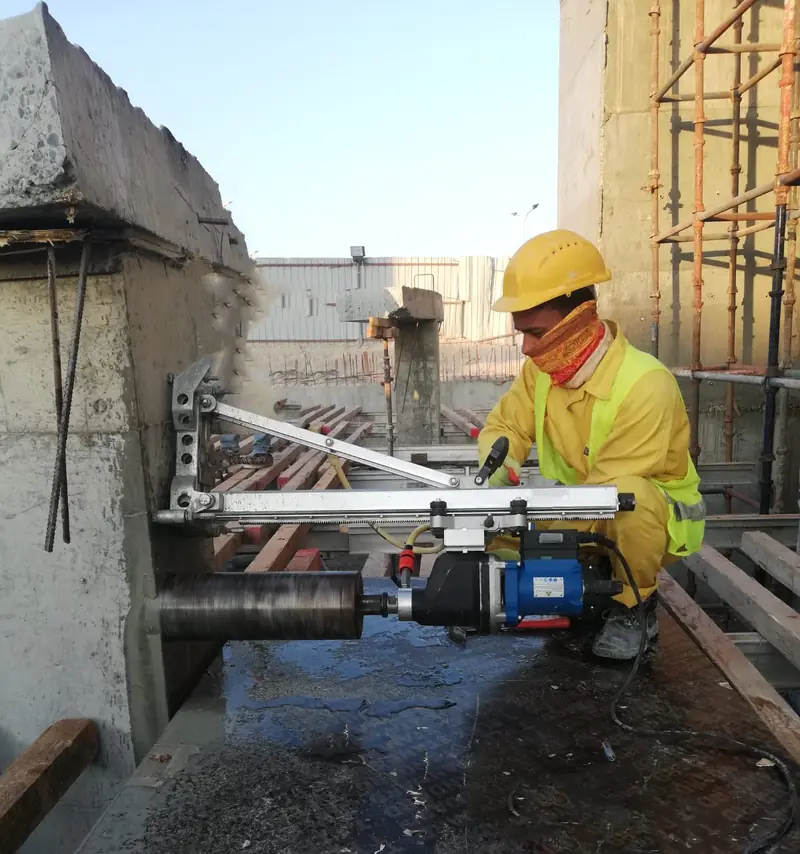
Core drilling on Thumama Stadium for CCC and at Hamad International Airport for Man Enterprise.
We provide concrete core drilling in Qatar from 6mm to 800mm in diameter, through reinforced concrete, block walls and stone. Most holes are wet-drilled with a diamond barrel, which keeps dust down and leaves a clean round hole. Where water is a problem, near electrics or on finished floors, we drill dry with dust extraction. Some site teams call this core cutting. It is the same work.
The usual jobs are MEP penetrations, HVAC and drainage openings, anchor holes and test cores for strength testing. Cutting time depends on diameter, depth, reinforcement and access. On post-tensioned slabs and transfer beams we recommend a GPR scan first, and we provide scanning on customer request.
How does core drilling work, step by step?
Site Assessment & GPR Scan
Our team inspects the location and, when you ask for it, runs a GPR scan to map embedded rebar, post-tension cables and utilities before any drilling begins. We recommend the scan on post-tensioned slabs.
Equipment Setup & Anchoring
The core drilling rig is securely anchored to the surface using vacuum pads or mechanical bolts. The correct diamond bit size is selected based on your project specifications.
Diamond Core Drilling
The operator engages the diamond-tipped barrel, which rotates at controlled speed with continuous water cooling (wet method) or dust extraction (dry method) to cut cleanly through concrete and rebar.
Core Extraction & Cleanup
The concrete core is carefully extracted, the hole is inspected for accuracy, and the work area is cleaned. Slurry and debris are collected and disposed of responsibly.
Where is core drilling used on Qatar sites?
MEP Penetrations
Precision holes for mechanical, electrical, and plumbing services through concrete slabs and walls in new builds and renovations.
HVAC Ducting
Large-diameter cores for air conditioning duct runs, ventilation shafts, and exhaust openings in commercial and residential buildings.
Plumbing Runs
Clean penetrations for water supply, drainage, and fire suppression pipe routes through reinforced concrete structures.
Electrical Conduits
Accurately sized holes for cable trays, conduit runs, and switchgear connections in industrial and commercial facilities.
Structural Testing
Extraction of concrete core samples for compressive strength testing and quality assurance per project specifications.
Anchor Bolt Holes
Precise holes for mechanical and chemical anchor installations to secure equipment, steelwork, and structural connections.
Expansion Openings
Series of overlapping cores to create larger openings for doorways, windows, or service access points in existing structures.
Load Testing Cores
Core samples extracted for laboratory analysis to determine concrete quality, carbonation depth, and reinforcement condition.
What diameters and depths can you core drill?
| Specification | Details |
|---|---|
| Diameter Range | 6mm to 800mm |
| Drilling Depth | Up to 3 meters and beyond with extensions |
| Orientations | Horizontal, vertical, and inclined drilling |
| Bit Technology | Diamond-tipped core barrels for concrete, rebar, and masonry |
| Drilling Methods | Wet drilling (water-cooled) and dry drilling (dust extraction) |
| Rig Mounting | Vacuum pad, anchor bolt, or stand-mounted systems |
| Power Options | Electric and hydraulic drive units for all site conditions |
What safety rules apply to core drilling in Qatar?
All core drilling operations at Aseel Constructions adhere to Qatar's construction safety regulations and international best practices. The work follows the agreed method statement and risk assessment. We offer GPR scanning to identify hidden hazards before drilling, maintain proper PPE protocols, and implement dust suppression and water management systems to protect workers and the environment. Our equipment undergoes regular maintenance and calibration to ensure safe, reliable performance on every project.
Frequently Asked Questions
Four things drive the price on almost every coring job: hole diameter, concrete thickness, rebar density, and access. A 100mm core through a 200mm slab in an open warehouse drills fast. A 400mm core through a post-tensioned transfer slab in a basement with restricted headroom is a different job entirely.
Number of holes matters too. A high-volume MEP coring program costs less per hole than a single one-off penetration. We assess the site before quoting, so the price you get reflects your actual conditions.
Duration depends on the hole diameter, concrete depth, reinforcement and access. Allow for setting up the rig and collecting the core as well as drilling. Send the drawing for a job-specific estimate.
On a 50-hole MEP program, the pace picks up significantly after the first few positions as the crew settles in. Give us your drawing and we'll give you a realistic daily production rate.
Diamond coring is quieter than most people expect. The bit rotates rather than hammers, so there's no percussive impact. Wet drilling suppresses airborne dust and drops noise further.
For occupied buildings such as hospitals, schools and active hotel floors, we schedule work during off-hours and position the rig to minimize transmission through the slab. We comply with Qatar municipality noise regulations and prepare method statements addressing shift timing when required.
Water feeds into the core barrel to cool the diamond segments and flush cuttings out. It returns grey, full of suspended concrete fines. Drillers call it slurry. We fit a collar ring around the drill and connect a wet vacuum to contain it before it spreads.
On interior fit-out jobs in Doha, we lay protection sheeting over finished floors and use absorbent barriers around the rig. On sites where drainage is limited, we bag the slurry for controlled disposal. The water stays contained.
The diamond segments will cut through rebar. That's not the concern. The concern is severing primary structural reinforcement that the engineer didn't intend to cut.
That's exactly why GPR scanning before coring matters on post-tensioned slabs and transfer beams. If our scan confirms a safe drilling position, we drill. If it flags a PT cable or a critical bar exactly where the opening is marked, we raise it with the engineer before the bit goes in. Avoiding that conversation after the fact is far more expensive than having it before work starts.
On request, and we recommend it. GPR scanning locates rebar, post-tension cables, conduits and embedded services before the bit goes in. Ask for it on post-tensioned slabs and transfer beams, near dense or unknown reinforcement, and wherever the as-built drawings are missing.
On a post-tensioned slab it is the difference between a clean penetration and a structural repair. If a scan flags a cable exactly where the opening is marked, we raise it with the engineer before drilling. On a plain ground-bearing slab with reliable drawings, the engineer can decide to skip it.
We run 24/7 across Qatar and average under two hours to respond. For urgent scopes inside Doha, same-day is normally possible once the permit is in place.
Night and weekend shifts are routine on occupied buildings, where the noise window is usually the real constraint rather than the cutting itself. Call +974 7066 1660 at any hour.
All of Qatar. Doha, Lusail, West Bay, The Pearl, Al Wakrah, Al Khor and the Industrial Area are regular ground for us, and we mobilise to project sites anywhere in the country.
Yes. Core cutting, core drilling and concrete coring all describe the same work: a hollow diamond barrel cuts a round hole and leaves the concrete core intact. We use the term concrete coring on this site.