
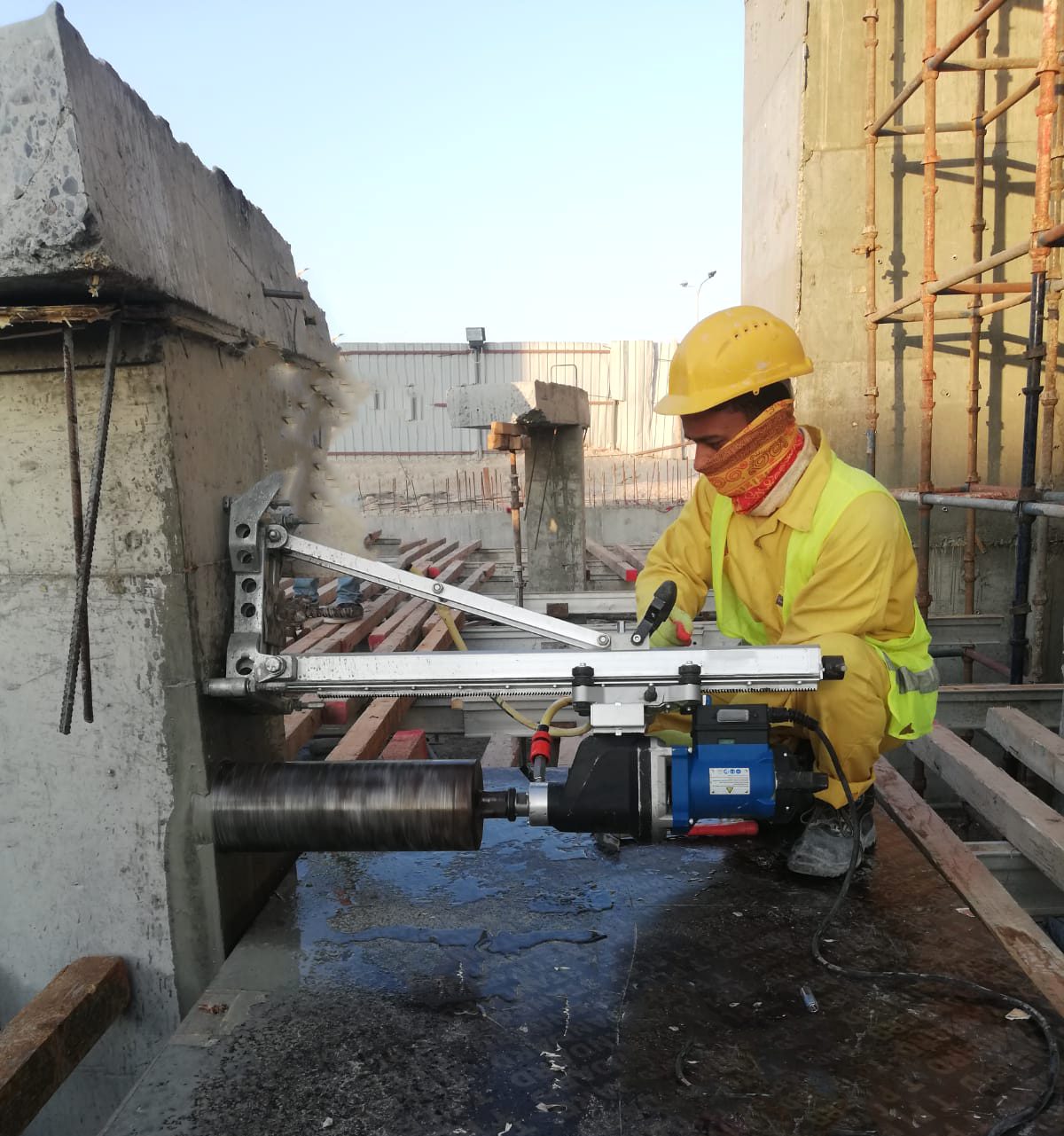
Sawing is the one operation that carries a published rate. Ours is QAR 150 to 500 per linear metre, depending on depth, location and access, and that figure is in our concrete cutting safety guide. Coring is different. Nobody quotes a rate per hole before seeing a drawing, because the same 200mm hole can take twenty-five minutes on a ground-floor warehouse slab and most of a day on level twelve of an occupied tower. Price follows time on site. Time follows seven variables.
Below is what each of those seven does to your number, a worked comparison of one identical hole in three different buildings, and the short list of details to send us so you get a firm price instead of a range. If you only read one section, read how to get an accurate quote in one email.
Why will nobody quote you a rate per hole?
Because a rate per hole only means something once you say where the hole is. Two jobs we ran in the same month: 180 penetrations through 250mm slabs in an empty ground-floor unit in the Industrial Area, and 14 penetrations through a 300mm post-tensioned slab on an occupied office floor in West Bay. The second job had fewer than a tenth of the holes and took longer.
Anyone who gives you a per-hole figure before seeing a drawing is either padding it heavily to cover the worst case, or they will come back with variations once the rig is on site. Neither is what you want on a fixed-price package.
How much do diameter and depth actually matter?
They matter, and they are the easy part. Diameter and depth are the two things we can price accurately from a drawing without ever visiting. Once the rig is anchored and the water is connected, cutting time is fairly predictable:
| Penetration | Element | Cutting time | Rig setup |
|---|---|---|---|
| 50mm conduit | 150mm wall or slab | About 5 minutes | 10 to 15 minutes |
| 150mm chilled water | 300mm post-tensioned slab | About 8 minutes with the right bit | 10 to 15 minutes |
| 300mm riser | 300mm, heavy reinforcement | 20 to 35 minutes | 10 to 15 minutes |
| 900 x 2100mm door opening | 200mm wall, single rebar layer | 2 to 4 hours, four cuts | Included above |
| Control joints, 50mm deep | C30 floor slab | 10 to 15 linear metres per hour | Per bay |
Notice the setup column. On a single hole, setting up costs more than cutting. That one line explains most of what follows.
What does reinforcement do to the price?
Diamond segments cut rebar. That is not the problem. The problem is cutting reinforcement the engineer did not intend you to cut, and the worst version of that is a post-tensioned tendon.
Post-tensioned slabs are everywhere in Lusail, The Pearl, Msheireb and West Bay. Nearly every multi-storey building put up there in the last fifteen years sits on them. Cable routes shift during the pour, so the as-built rarely matches the drawing to the millimetre.
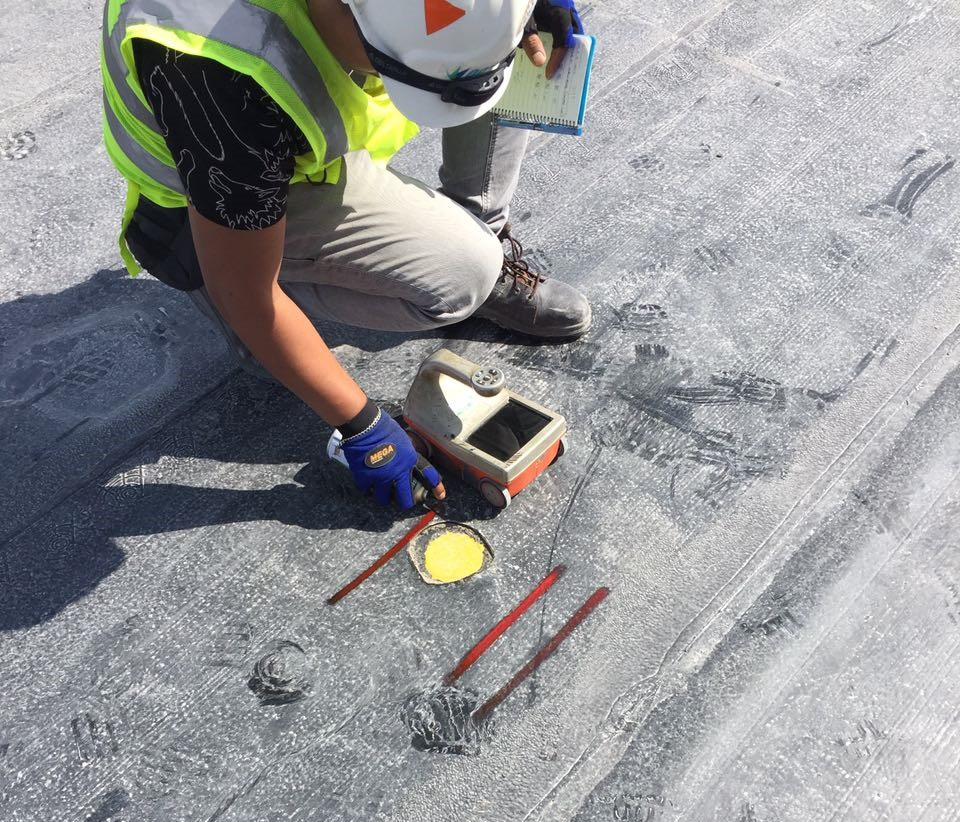
What a strike actually costs you. A 400MHz scan of one penetration takes 15 to 20 minutes. Cutting a stressed tendon stops work on that floor for weeks: a remedial engineer assesses it, designs a repair, and signs it off before anyone continues. Against that, the scan is not a cost. It is the cheapest line on the quote.
Rebar density also decides the bit. A soft-bond diamond segment cuts hard concrete faster because the diamonds shed at the right rate and keep cutting. A hard bond lasts longer in softer material. Get that pairing backwards and the barrel glazes over, the operator leans on the machine, the motor overheats and the hole goes out of tolerance. A 150mm hole that should take eight minutes takes twenty-five, and the bit is finished. Crews that carry one grade of segment in the truck are cheaper to hire and slower on site.
How does access change the cost?
Access is the variable that surprises people most, and it is usually the largest. A core rig, a generator, hoses, a wet vacuum and a barrel set have to reach the hole.
- Ground floor, roller shutter, park the van next to the work. Fastest case.
- Level twelve with a working hoist and a booked slot. Add the wait for the hoist, twice.
- Basement three with 1.9m headroom. Standard rigs will not stand up. Short barrels plus extensions, more repositioning, slower cutting.
- Stairs only. Everything is carried, and there is a limit to what two people carry safely.
Tell us the floor level and how the equipment gets there. It changes the number more than the hole diameter does.
Does night work cost more?
Yes, and not because of the cutting. Cutting at 2am takes exactly as long as cutting at 2pm. What costs money is everything wrapped around a night shift in a live building: sheeting the finished floors, agreeing noise limits with the building manager, a banksman for the hoist, and a full clean before tenants arrive.
Wall sawing runs 85 to 95 decibels measured at the saw. That is well under a breaker on the same wall, and still too much for a hotel corridor at 11pm without an agreement in place. Where we can, we push large-diameter work into early mornings or night shifts in summer anyway, because Doha roof temperatures touching 55C shorten bit life and slow cutting on their own.
Who pays for slurry and dust control?
Wet cutting is what keeps silica out of the air, and OSHA's permissible exposure limit for respirable crystalline silica is 50 micrograms per cubic metre over an eight-hour shift. Water on the blade cuts airborne dust dramatically. It also produces grey slurry that has to go somewhere.
On a bare structure, slurry runs to a collar ring and a wet vacuum and that is the end of it. On a fitted-out floor with carpet and painted skirting, containment is real work: sheeting, absorbent barriers, bunding at the door, and bagging the slurry where drainage is limited. Slurry gets managed at the cut face, not mopped off a finished floor twenty minutes later. If a quote for work on a finished floor has no line for containment, the person who wrote it has not thought about your floor.
Is a fifty-hole programme cheaper per hole?
Considerably. Mobilisation, permits, scanning setup and crew travel are mostly fixed per visit. Spread across one hole they dominate the price. Spread across fifty in the same location they nearly disappear, and the crew speeds up after the first few positions once they settle into the layout.
Which leads to the most useful commercial advice in this article: batch your penetrations. If the MEP team can confirm 60 positions now instead of 20 now and 40 in three weeks, the second option costs you two mobilisations and a slower rate on both.
What is standby time, and why does it wreck budgets?
Standby is our crew and rig sitting on your site, on the agreed day, unable to start. The usual causes are the same four every time: the permit was not issued, the area was not cleared, there is no water or power at the location, or nobody can find the person who signs off the penetration.
We bill it, and so will anyone else. We would rather put the rate in the quote and tell you what it is than surprise you later. The way to pay none of it is to confirm permits, access and services the day before, not the morning of.
Worked example: one 200mm core, three buildings
| A. Warehouse, ground floor | B. Occupied tower, level 12 | C. Basement 3, transfer slab | |
|---|---|---|---|
| Element | 250mm slab, light mesh | 300mm post-tensioned | 600mm transfer slab |
| GPR | Not required | 20 minutes, mandatory | 20 minutes plus engineer sign-off |
| Access | Van at the door | Booked hoist slot | 1.9m headroom, short barrels |
| Shift | Daytime | Night only | Daytime |
| Containment | None | Sheeting, bagged slurry | Minimal |
| Total site time | About 25 minutes | About 2 hours | Most of a day |
Same diameter. Same drawing symbol. Three different jobs. That is why the first thing we ask for is the drawing and the floor level, not the hole count.
How to get an accurate quote in one email
Send these ten lines and you will get a firm price, usually within two hours, without a back-and-forth. Copy the block, fill it in, attach the drawing.
Concrete cutting enquiry
- Site name and floor level
- Element: slab, wall or beam, and its thickness
- Post-tensioned? Yes / No / Unknown
- Hole diameters and quantity, or opening sizes
- Structural and MEP drawings attached? Yes / No
- Access route: lift, hoist, stairs, and headroom
- Working hours permitted on site
- Is the building occupied?
- Water and power available at the work location?
- Date the work needs to be finished
Send it to [email protected] or WhatsApp the drawing to +974 7066 1660.
Item 3 is the one people skip. If you genuinely do not know whether the slab is post-tensioned, write Unknown. We would rather scan and find out than assume and be wrong.
Five red flags when you compare cutting quotes
- A per-hole rate quoted before anyone has seen a drawing. It is either padded or it will grow.
- GPR listed as an optional extra on a post-tensioned slab. That is not a saving, it is a gap in the scope.
- No containment line for work on a finished floor. Someone is going to pay to clean that carpet.
- Nothing about who supplies water and power. This becomes an argument on the day.
- Standby left undefined. Undefined does not mean free, it means unpriced.
None of that means the cheapest quote is wrong. It means you should be able to see, line by line, what the cheap one has left out.
Frequently asked questions
What is the going rate for concrete cutting in Qatar?
Sawing is quoted per linear metre and ours runs QAR 150 to 500, set by depth, location and access. Renting equipment and cutting it yourself runs QAR 50 to 150 per metre, but that number excludes labour, training, insurance and compliance, which is why it is not the cheaper option once anything goes wrong. Coring is quoted per hole and has no list rate, for the reasons below.
How much does concrete coring cost in Qatar?
There is no single rate, because the same hole can take 25 minutes or half a day depending on where it is. Price follows time on site, and time follows seven variables: hole diameter, element thickness, reinforcement density, access, the shift you are allowed to work, how much containment the area needs, and how many holes are in the scope. Send a structural drawing with the penetrations marked and we will price it properly instead of guessing. Per-hole cost drops sharply once a job runs past roughly twenty holes in one location, because the setup and mobilisation are spread across all of them.
Is GPR scanning an extra charge or included?
We quote it as its own line so you can see what it costs. On a post-tensioned slab it is not optional. A 400MHz scan of one penetration takes 15 to 20 minutes. Cutting a stressed tendon stops work on that floor for weeks while a remedial engineer assesses the damage, designs a repair and signs it off. Any quote that leaves GPR off a post-tensioned slab is not cheaper, it is incomplete.
Why does night work cost more?
Because the crew is paid for the shift whether the permit lands on time or not, and because night work in an occupied building carries setup you do not need at 9am on an empty site: floor protection, noise limits agreed with the building manager, a banksman for the hoist, and a full clean before the tenants arrive. The cutting itself takes the same time. Everything around it does not.
Do you charge for standby time?
Yes, and you should expect any contractor to. If our crew and rig are on site at the agreed time and cannot start because the permit is not issued, the area is not cleared, or there is no water or power at the location, that time is billed. We would rather write it into the quote and tell you the number than surprise you with it later. The way to pay none of it is to confirm access, permits and services the day before.
Can you quote without visiting the site?
For straightforward scopes, yes. A set of structural drawings with the penetrations marked, the slab thickness, the floor level and the allowed working hours is usually enough for a firm number. We ask for a site visit when the element is post-tensioned, when headroom is under about two metres, when the building is occupied, or when nobody can tell us what the slab thickness is.
Who supplies water and power?
Normally the main contractor, at the work location. Wet cutting needs a continuous feed, and a large-diameter core on an underpowered socket damages the barrel. If water and power are not available at the point of work we can bring a tank and a generator, but it is a cost and it is better agreed before the crew arrives than argued about on the day.
Send the drawing. Get a real number.
We are a licensed concrete coring and cutting contractor based in Doha, working across Qatar since 2016. Most enquiries get a first response inside two hours, and a detailed quote once the scope is confirmed.