
Diamond Wire Sawing in Qatar
A wall saw reaches about 730mm. Diamond wire keeps cutting beyond that, so we use it for foundations, piles, bridge decks and heavily reinforced sections.
A diamond wire saw pulls a loop of wire, set with diamond beads, through concrete at high speed while water cools the cut. Our wall saws reach about 730mm from one face. Wire has no such limit, so we use it when the section is thicker than that, when a track cannot be mounted, or when the cut has to follow a curve or sit flush against a surface.
Aseel runs diamond wire sawing in-house, alongside wall sawing, core drilling and controlled demolition. That helps on thick-section jobs, because the access holes are usually core drilled and the cut pieces often go straight into a demolition sequence. One contractor plans the whole cut.
Typical jobs are massive foundations, piles, bridge decks and piers, thick walls and slabs in industrial structures, and reinforced sections that come out in pieces a crane can lift. Send us the section size and the access, and we confirm the setup before we come to site.
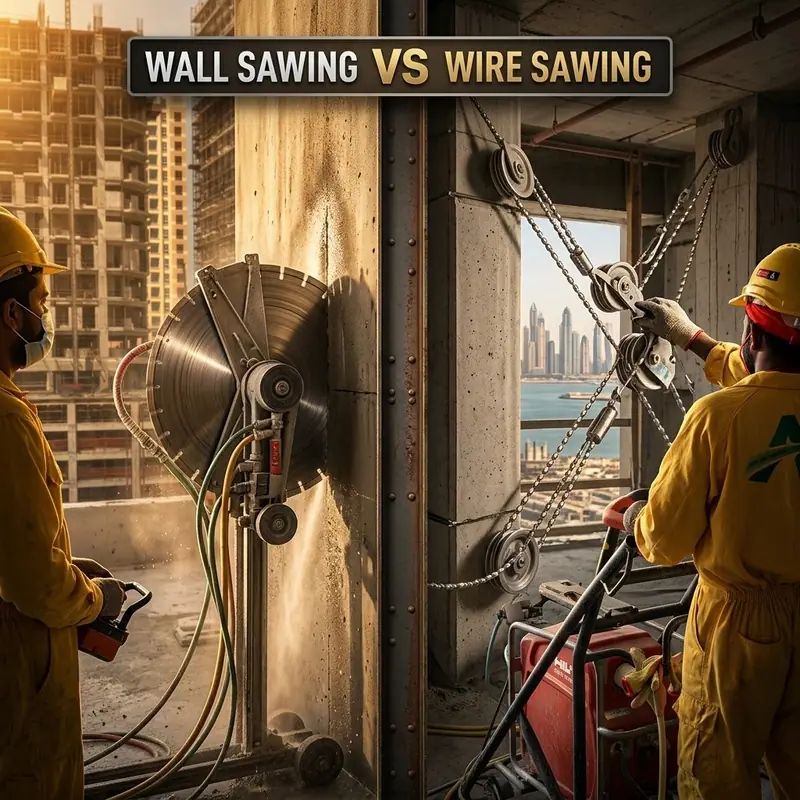
When does wire sawing beat wall sawing?
Choose wire sawing when the concrete is thicker than about 730mm, when the cut is curved or irregular, when you need a flush cut with no blade overcut at the corners, or when there is no room to mount a wall saw track. For standard door, window and service openings in walls and slabs, wall sawing is quicker and costs less.
| Factor | Wall sawing | Diamond wire sawing |
|---|---|---|
| Section thickness | About 730mm from one face | Not set by the saw. Limited by access and by how the pieces can be lifted |
| Cut shape | Straight lines | Straight, curved or irregular |
| Corners | Blade overcut at inside corners | No overcut |
| Setup | Track bolted to the surface, quick | Access holes core drilled, pulleys and drive unit set, longer |
| Typical use | Openings in walls and slabs | Foundations, piles, bridge decks, large concrete masses |
| Cost | Lower for standard openings | Higher: specialised equipment and diamond wire |
Not sure which method your job needs? Our guide compares both in detail: wall sawing vs wire sawing. Or send us the drawing and we will tell you.
Where is diamond wire sawing used?
Massive Foundations
Cutting thick footings and raft sections for modification or removal, in pieces sized for the crane.
Piles and Pile Caps
Trimming piles to level and cutting pile caps where a circular blade cannot reach through the full section.
Bridge Decks and Piers
Removing deck sections and piers in controlled pieces, with no impact blows travelling through the structure.
Heavily Reinforced Structures
Cutting thick concrete with dense reinforcement, where depth and blade wear rule out other methods.
Underwater and Wet Work
The method works under water, which suits marine structures and elements below the water table. Send us the depth and access first.
Limited Access
Pulleys fit where a wall saw track and blade cannot be mounted, such as around columns and in plant rooms.
How does diamond wire sawing work, step by step?
Survey and Method
We review the drawings and the structure, agree the cut lines with your engineer, and plan how each piece will be supported and lifted. GPR scanning can be added before drilling if you ask for it.
Access Holes
Holes are core drilled through the structure at the start and end of each cut so the wire can pass through. We set the positions so the wire path stays clear.
Pulleys and Wire
Guide pulleys and the drive unit are fixed to a rigid base. The diamond wire is threaded through the holes and around the pulleys into a closed loop, then tensioned.
Cutting
The drive unit pulls the wire through the concrete with continuous water on the cut. The operator sets speed and tension from a safe position.
Lifting and Cleanup
Each piece is supported or rigged before the final separation, then lifted away. Slurry, offcuts and wire waste are removed from site.
What safety and site requirements apply to wire sawing?
Wire sawing needs a clear exclusion zone along the whole wire path, because the wire runs under tension at high speed. We fence that zone, keep other trades out of it and run the saw from outside it. Before we start we prepare a method statement and a risk assessment for the job.
Each cut piece needs a lifting plan. We rig or support it before the last cut, so it does not drop or shift when the wire breaks through.
Water is needed throughout the cut for cooling and dust control, and the slurry has to be channelled, collected and removed. GPR scanning is available on request, and we recommend it before drilling the access holes or cutting near rebar, post-tension cables or buried services.
What we need from you
- Drawings or a clear description of the element to be cut
- Its thickness and the approximate length of the cut
- Access to both sides of the structure, or to the cut line
- A water supply and a drainage point, and a power source if the drive is electric
- Crane or lifting arrangements for removing the pieces, and any permits the site requires
Frequently Asked Questions
Diamond wire sawing cuts concrete with a continuous loop of wire set with diamond beads. A drive unit pulls the wire through the structure at high speed, and water cools the cut. Because the wire is flexible and runs around pulleys, it can cut sections far thicker than a circular blade can, and it can follow curved or irregular lines.
Choose wire sawing when the concrete is thicker than about 730mm, when the cut is curved or irregular, when you need a flush cut with no overcut at the corners, or when there is no room to mount a wall saw track. Typical examples are foundations, piles, bridge decks and piers. For standard openings in walls and slabs, wall sawing is quicker and costs less.
The saw does not set the limit. A wire saw can cut structures several metres thick, and the practical limits are access to both sides, how the pieces will be supported and lifted, and the length of wire. We confirm the section size and the cut sequence on site before work starts.
Yes. The diamond wire cuts through rebar and concrete together. Dense reinforcement slows the cut and wears the wire faster, so heavily reinforced sections take longer. On request we scan with GPR first to map the bars and any post-tension cables, which is worth doing before the access holes are drilled.
Yes. Water runs on the wire throughout the cut to cool the beads and keep dust down. The slurry is channelled away from the cut, collected with dams and vacuum hoses, and removed from site.
Tell us if the work is above finished areas or near electrics, so we can plan the water control before we start.
The method works under water, and it is one of the reasons contractors choose wire for marine structures and for elements below the water table. Send us the water depth, the section size and the access conditions, and we will confirm whether we can take the job.
For a standard opening, yes. Wire sawing uses specialised equipment, takes longer to set up and uses diamond wire that costs more per metre of cut. For a section a wall saw cannot cut, the comparison does not apply, and picking the wrong method usually costs more in delays. We price after we have seen the drawings and the access.
Send the drawing or a description of the element, its thickness, the length of the cut, the site location, the access to both sides and the date you need the work done. Call +974 7066 1660 or WhatsApp the details, and we reply with the method and a price.