
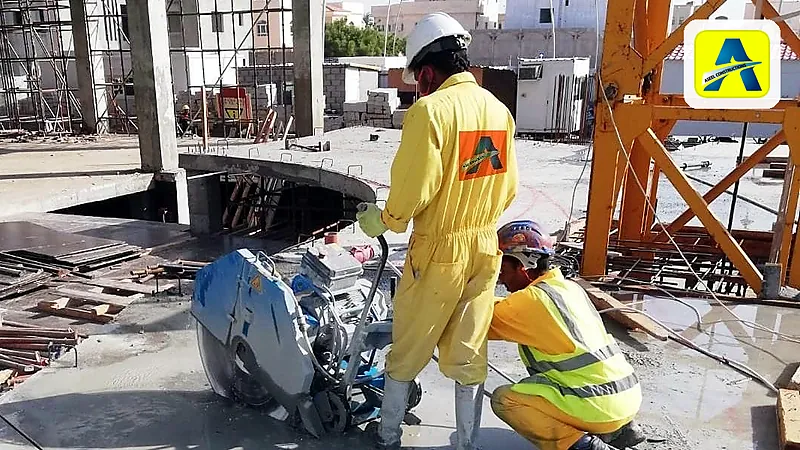
Control joints, explained
Hard enough for the blade. Before it cracks.
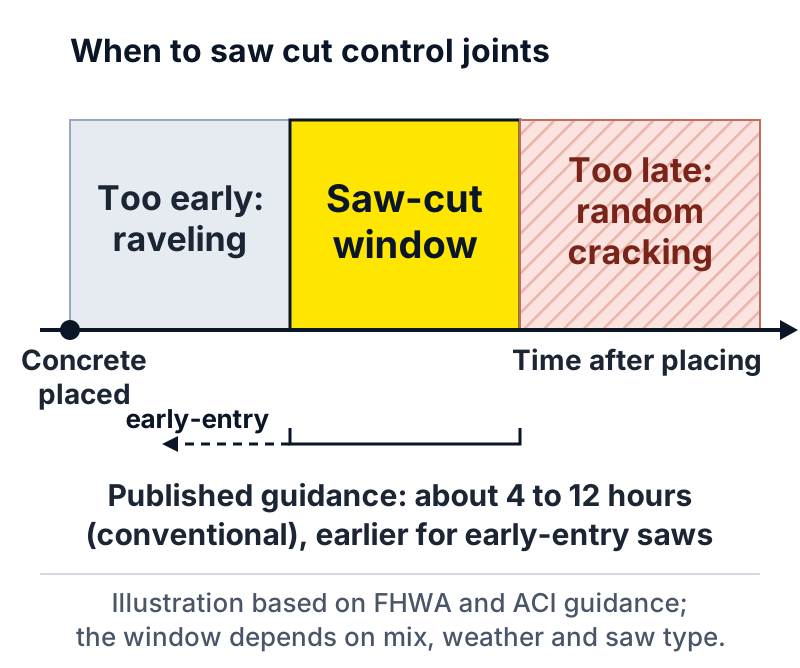
Published guidance says control joints are sawn once the concrete is firm enough that the blade does not ravel the edges, and before random shrinkage cracks form. ACI and FHWA guidance puts that at roughly 4 to 12 hours after placing for conventional saws, and earlier for early-entry saws and in hot weather. The slab designer sets layout and depth.
- ACI's FAQ says cuts are typically made within 4 to 12 hours after placing, depending on temperature and weather. FHWA gives about 4 to 12 hours after paving.
- Too early, the cut ravels. Too late, random cracks can form before the joint does its job (FHWA).
- Depth guidance differs between sources: one quarter of the slab, one third, or shallower for early-entry saws. The project specification sets the depth.
- Book the saw crew against the pour schedule.
What does a saw-cut control joint do?
Concrete shrinks as it dries and cools. FHWA's TechBrief on early-entry sawing says joints are placed mainly to prevent uncontrolled, random cracking caused by temperature, moisture and shrinkage, and that these forces are most acute in the first 72 hours after placement. A saw cut makes a weakened plane, so the crack forms under the cut instead of across the panel.
Both FHWA documents cited here are written for concrete pavements. ACI's answer covers slabs in general and calls these cuts relief cuts.
How soon after pouring should control joints be cut?
ACI's FAQ on saw cut timing, citing ACI 302.1R-15, says saw cutting should happen before random drying-shrinkage cracks form and when the surface is firm enough not to be damaged by the blade. It adds that cuts are typically made within 4 to 12 hours after placing, depending on temperature and weather.
FHWA's TechBrief gives the same broad range: about 4 to 12 hours after paving. It also says the timeframe varies considerably with the materials, the mix, external restraint and the environment. Timing is often based on the operator's experience and a scratch test of the surface hardness.
A jointing guide hosted by pacaweb.org (the page does not name its publisher) puts it plainly: saw as soon as the concrete can take the energy of sawing without raveling or dislodging the aggregate.
So treat the hours as a planning range. The crew judges the window on the concrete on site.
What happens if you cut too early or too late?
A summary of the published wording, not a test method.
Swipe to see all columns
| Timing | What you see | What it means | Source |
|---|---|---|---|
| Too early | Raveling: chipped cut edges, aggregate pulled out by the blade | The surface is not yet firm enough for the saw | FHWA TechBrief; FHWA-HIF-23-041; pacaweb.org guide |
| In the window | A clean cut with no raveling, made before any random cracks | The crack can form under the cut, in the planned line | ACI FAQ 915; FHWA TechBrief |
| Too late | Random cracks across the panel, away from the joint lines | Stresses built up before the joint was cut | FHWA TechBrief; FHWA-HIF-23-041 |
| Cracks already showing before sawing | A crack crossing the slab where no joint has been cut yet | ACI's guidance is to saw before these form; ask the slab designer how to treat it | ACI FAQ 915 |
| Early-entry saw raising dust | Dust coming off the cut | FHWA's findings sheet says to switch to conventional sawing | FHWA-HIF-23-041 |
FHWA says the later limit is of particular concern, because the longer sawing is delayed, the greater the chance of random cracking.
Do early-entry saws change the window?
Yes, they start earlier. FHWA's TechBrief says early-entry saws are much lighter than conventional saws and can often be used as soon as workers can walk on the concrete. It says early-entry sawing typically begins 1 to 4 hours after paving. FHWA's findings sheet FHWA-HIF-23-041 says within an hour or two of paving. ACI's FAQ, citing ACI 325.12R, gives 2 to 6 hours for early sawing, with hotter conditions needing cuts sooner.
The Husqvarna 50 operator's manual for its early-entry saw says contraction joints should be sawn as soon as the concrete will support the weight of the saw. If your specification names early-entry sawing, say so when you send the pour schedule so we can confirm the saw type before the pour.
Does hot weather shorten the saw-cut window?
ACI's FAQ, citing ACI 224.4R-13, says that in hot weather saw cuts may need to be placed within 1 hour, while in cold weather they can typically be delayed to about 4 hours. It also says that on hot, dry or windy days initial cracking can occur rapidly. It lists fogging, monomolecular films and nighttime placement as ways to manage those conditions (ACI 302.1R-15).
On a hot-weather pour, this guidance points to an earlier window, so we plan the crew's arrival around the pour start time. The start is still called on the concrete itself.
How deep should control joints be cut?
The sources do not agree on one figure, and they cover different saws and slabs:
- ACI's FAQ: conventional cuts generally one-fourth the depth of the slab (ACI 327R-14). Early-entry saws can cut shallower and still be effective (ACI 224.4R-13).
- FHWA TechBrief: often one quarter of the slab thickness for transverse contraction joints and one third for longitudinal ones. Others say always at least one third, and some advocate a shallower cut of at least 25 mm if sawing is early enough.
- FHWA-HIF-23-041: conventional joint depth typically one third of the pavement thickness. Early-entry transverse cuts about 1 inch.
- Husqvarna 50 manual: its sawed contraction joints at least one eighth of the concrete depth and at least 25 mm.
On a 200 mm slab, one quarter is 50 mm and one third is about 67 mm. Which fraction applies is a design decision: the specification sets the depth, and the crew cuts to it. Our floor and road sawing service runs walk-behind and ride-on saws that cut up to 500 mm deep.
Control, expansion or construction joint: which one is sawn?
The pacaweb.org jointing guide names three types. Contraction (control) joints are placed to let the panels shrink. Isolation joints separate fresh concrete from any fixed structure. Construction joints are butt joints formed where placing stops.
A saw crew cuts the contraction joints in a new slab. The guide does not use the term expansion joint. If your drawing says expansion joint, ask the designer which joint is meant before you book the saw. Our guide to concrete cutting methods explains where floor saws fit among the other cutting tools.
What to send the saw crew before the pour
This is information we ask for to plan the crew around your pour. It is not engineering advice: the designer and the specification set the joints.
- Slab thickness, and where it changes.
- The joint layout drawing from the slab designer.
- The specified joint depth, and whether the specification names a saw type.
- Pour date, planned start time and expected finishing time for each bay.
- The bay sequence, if the floor is poured in phases.
- Total linear metres of joints, if you have them.
- Access for the saws, power, and water. Our cutting is wet and the slurry is vacuumed at the blade.
- Whether hardener, power floating or other finishes go on, and when.
- The name of the site contact who confirms the concrete is ready.
Frequently asked questions
How many hours after pouring are control joints cut?
ACI's FAQ says cuts are typically made within 4 to 12 hours after placing the slab, depending on temperature and weather. FHWA gives about 4 to 12 hours after paving for conventional saws, and earlier for early-entry saws. The concrete on the day decides where your slab sits in that range.
Is it too late to cut joints the next day?
None of the sources gives one cut-off hour for every slab. FHWA says the longer sawing is delayed, the greater the chance of random cracking. If cracks have already formed, ask the slab designer how to treat them before sawing.
How deep should a control joint saw cut be?
Published guidance differs. ACI's FAQ gives one-fourth of the slab depth for conventional cuts, an FHWA findings sheet says one third, and early-entry cuts can be shallower. The depth in your project specification is the one the crew cuts.
What is the difference between a control joint and an expansion joint?
A sawn control (contraction) joint lets the slab shrink and crack along a planned line. The joint that separates new concrete from a fixed structure is called an isolation joint in the jointing guide we cite. If your drawing says expansion joint, ask the designer which joint is meant.
What do you need from us to plan joint cutting?
The floor layout, total linear metres, the specified depth and the pour schedule. Slab thickness, the bay sequence and site access, power and water help us plan the crew.
Have a slab pour coming up?
Send the joint layout, specified depth and pour schedule through our contact page, or call +974 7066 1660 or +974 5077 6363. You can also email sales@smartcutqa.com. Saw types and cutting depths are on our floor and road sawing page.
Send the slab layout and pour schedule for a quotation Call +974 7066 1660 WhatsApp the pour schedule
Sources
- American Concrete Institute, When should saw cuts be made on a concrete slab? (FAQ 915, citing ACI 302.1R-15, ACI 325.12R-02(19), ACI 224.4R-13, ACI 327R-14 and ACI 325.9R-15)
- Federal Highway Administration, Early-Entry Sawing of Portland Cement Concrete Pavements, CPTP TechBrief FHWA-HIF-07-031 (June 2007)
- Federal Highway Administration, Mobile Concrete Technology Center, MCTC Findings: Saw Cutting for Concrete Paving, FHWA-HIF-23-041
- Husqvarna, Husqvarna 50 operator's manual, page 11: Sawing contraction joints (third-party manual host)
- Jointing Concrete, guide hosted on pacaweb.org (publisher not named on the page)
- Aseel Constructions, Floor and road sawing service
All accessed 1 November 2026.