

Wall saw overcuts, explained
A round blade does not stop at a square corner.
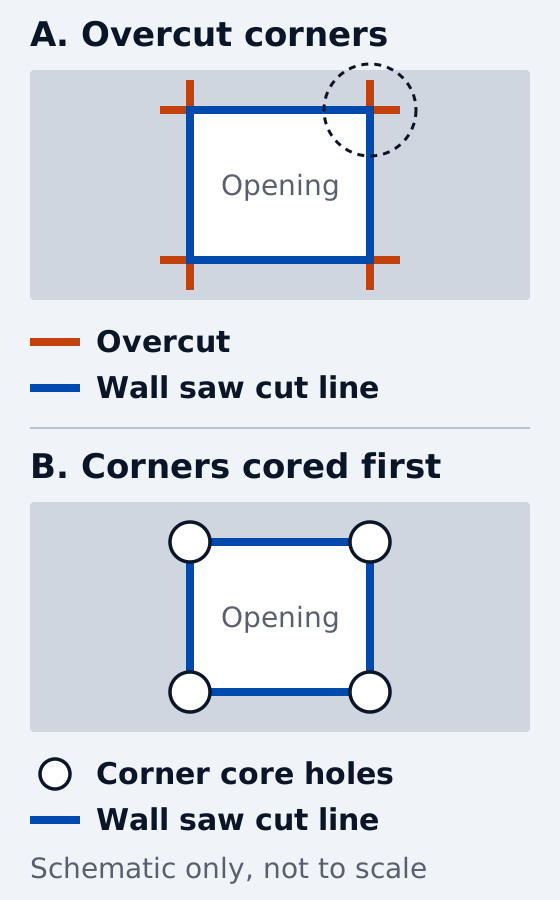
An overcut is the extra cut a round wall saw blade leaves past each corner of an opening. The blade has to travel beyond the corner to cut the full wall depth. Hilti's wall saw manual says to check whether overcutting at corners is permitted before work starts, and to drill corner holes first if it is not.
- A circular blade cannot finish a square inside corner on its own, so the cut runs a little past it.
- Its length depends on the wall thickness, the blade, and how deep the blade can plunge (Husqvarna and Hilti manuals).
- Hilti's manual puts the decision with the site engineer or site management, before sawing starts.
- If overcuts are not permitted, the corners are cored first, finished with another tool, or the opening is cut with a diamond wire.
- Write the answer on the drawing you send for a quotation.
What is a wall saw overcut, and why does a round blade make one?
A wall saw cuts with a circular diamond blade that travels along a steel track bolted to the wall. You can see the setup on our wall sawing service page. Because the blade is round, the slot it cuts is longest on the face where the saw is mounted and shorter towards the far face. To bring the cut through the full depth right up to a corner, the slot on the near face has to run past that corner. That extra length of kerf is the overcut.
The Journal of Light Construction put it in one line in a 2007 article on a US cutting crew: "the big circular blade on the wall saw can't cut through without overcutting the corners." A Hilti patent on wall saw control describes the overcut as the way the cut reaches its full end depth at the end point, and notes that "an overcut may be permitted at a free end point without an obstacle."
On a finished opening, the overcut shows as a thin saw line running beyond each corner on the face or faces the saw worked from. Our wall sawing vs wire sawing comparison lists the overcut as one of the differences between the two methods.
What sets the length of an overcut?
There is no single figure. Husqvarna's WSC 40 wall saw operator's manual says: "The overcutting length depends on the thickness of wall and what blade that is used."
Hilti's DS TS5-SE wall saw operating instructions add a third factor. They say different overcutting distances result depending on the application and on whether or not the saw blade can be plunged to its maximum depth. The tips section says a short contact length always gives the shortest possible overcutting distance at the corners of window and door openings.
Both manuals give figures for their own saw and blade, so we do not repeat them here. For your wall, we confirm the length once we have seen the drawing.
Who decides whether overcuts are allowed?
Not the saw crew. In its safety measures before sawing, the Hilti DS TS5-SE manual says: "Find out whether overcutting at corners is permitted." Its general warnings add that approval must be obtained from the site engineer or site management before beginning sawing work or drilling corner holes.
So the question goes to the engineer responsible for the opening, or to site management, before the track goes up. We do not tell clients whether an overcut is acceptable in a given wall. That is a structural decision, and our job is to ask it early and cut to the answer.
Manufacturers sell to this need. Husqvarna lists "No overcutting" as a feature on its WSC 40 product page, giving the example of cutting door openings.
What are the options at the corners?
Saw through where overcuts are permitted
If the engineer or site management permits overcuts, the blade cuts each side of the opening straight through to full depth. This is the shortest sequence. Get the approval in writing or on the drawing, so nobody on site has to guess on the day.
Drill core holes at the inside corners first
Hilti's manual gives this as the alternative: if overcutting is not permitted, the corresponding corner holes must be planned and drilled first. The holes are cored through the wall at each inside corner, and the saw cuts run into them, so the blade does not need to run past the corner.
This is how we handle openings that must not be overcut. Our wall sawing page states it: where an opening must not be overcut, we finish the inside corners with core holes. The holes are part of our core drilling service. A cored corner is rounded, not a sharp right angle. If the frame or finish needs a square corner, say so when you send the drawing.
Hilti's manual asks for approval before corner holes are drilled too. If reinforcement or embedded services near the corners are a concern, ask for a GPR scan first. We scan on request. The engineer still reviews the cut path, because a scan does not guarantee every object is found.
Finish the corners with another tool
Manufacturer and trade sources describe other ways to finish a corner after the blade stops short:
- In Husqvarna's WSC 40 manual, the blade is swapped for a wall saw chain attachment, which cuts the remaining material to get sharp corners.
- The 2007 JLC article describes crews scoring the corners with a small electric cutoff tool, then chipping out the rest with a small pneumatic chisel.
- Equipment World (2003) describes a chain-style concrete saw built to cut square corners and small openings that circular saws cannot manage without overcutting.
These describe what the sources say, not a list of our equipment. Ask us which corner method we would propose for your opening.
Use wire sawing for a flush cut
A diamond wire does not have a blade radius. We use wire sawing when you need a flush cut with no blade overcut at the corners, and also when the section is thicker than a wall saw can reach or the cut follows a curve.
Which corner option fits your opening?
A summary to discuss with your engineer, not a design rule.
Swipe to see all columns
| Situation | Option to discuss | Who confirms | Source |
|---|---|---|---|
| Overcuts permitted | Saw each side through to full depth | Site engineer or site management (get it in writing) | Hilti DS TS5-SE manual |
| No overcut, rounded corners acceptable | Core holes at the inside corners, drilled before sawing | Engineer approves the holes before drilling | Hilti DS TS5-SE manual; Aseel wall sawing page |
| No overcut, square corners required | Blade stops short, corners finished with another tool | Engineer; the cutting contractor proposes the method | Husqvarna WSC 40 manual; JLC 2007; Equipment World 2003 |
| Flush cut, curved cut or very thick section | Wire sawing | Engineer | Aseel wire sawing page |
| Reinforcement or services near the corners unknown | GPR scan before coring or sawing, on request | Engineer reviews the cut path | Aseel wall sawing page |
What to put on the drawing and send for a quotation
This is the information we ask for to plan and price the cut. It is not engineering advice: the engineer sets the opening detail.
- Opening sizes and position, with the wall thickness.
- A note on each opening: overcuts permitted, or no overcut.
- If no overcut: whether rounded corners from core holes are acceptable, or square corners are required.
- Any corner hole size or position the engineer has specified.
- Which face stays exposed or finished, and whether you can reach both faces.
- Whether you want a GPR scan before cutting.
- Floor level, working hours, access for the track, and power and water. The saw is water-cooled, so tell us about drainage.
- How the cut section will be supported and removed, if the site has a plan for it.
Frequently asked questions
What is an overcut in wall sawing?
It is the part of the saw cut that runs past the corner of an opening. A round blade has to travel beyond the corner to cut the full wall depth there, so a short slot shows on the face the saw worked from.
Can a wall saw cut a square corner without overcutting?
Not with the round blade alone. The usual alternatives are core holes drilled at the inside corners before sawing, finishing the corners with another tool after the blade stops short, or wire sawing for a flush cut.
Who decides if overcuts are allowed?
Hilti's wall saw manual says to find out whether overcutting at corners is permitted, and that approval must come from the site engineer or site management before sawing or drilling corner holes. The saw crew does not make that call.
How long is a wall saw overcut?
There is no single figure. Husqvarna's manual says it depends on the wall thickness and the blade, and Hilti's manual adds whether the blade can plunge to its maximum depth. We confirm it once we see the drawing.
What should I send for a wall opening quotation?
The opening sizes and wall thickness, a note saying whether overcuts are permitted, and whether square or rounded corners are needed. Floor level, working hours, access to both faces and any GPR scan request help us plan the crew.
Planning a new opening in a concrete wall?
Send the drawing, the wall thickness and the engineer's note on overcuts through our contact page, or call +974 7066 1660 or +974 5077 6363. You can also email sales@smartcutqa.com. Cutting depths and the track setup are on our wall sawing page.
Send the opening drawing for a quotation Call +974 7066 1660 WhatsApp the drawing
Sources
- Hilti, DS TS5-SE electric wall saw operating instructions (safety measures, overcutting section 3.4, tips and tricks 6.3)
- Husqvarna, WSC 40 operator's manual, page 15 (third-party manual host)
- Husqvarna, WSC 40 wall saw product page
- Hilti AG, US patent US10569446B2, Method for controlling a wall saw system when making a separating cut
- Rick Schwolsky, Cutting Concrete: How a Pro Breaks Through, Journal of Light Construction, May 2007
- Equipment World, Chain-style concrete saw cuts corners, July 2003
- Aseel Constructions, Wall sawing service and Wire sawing service
All accessed 2 November 2026.