
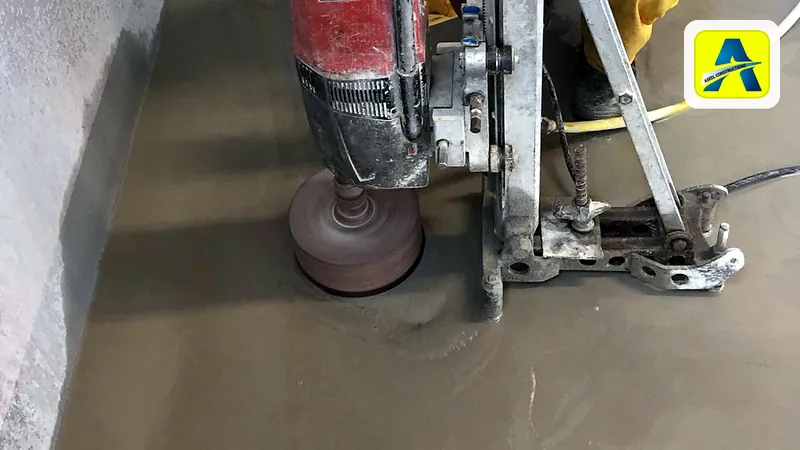
Core rig fixing, explained
The rig has to stay put. Agree how before it arrives.
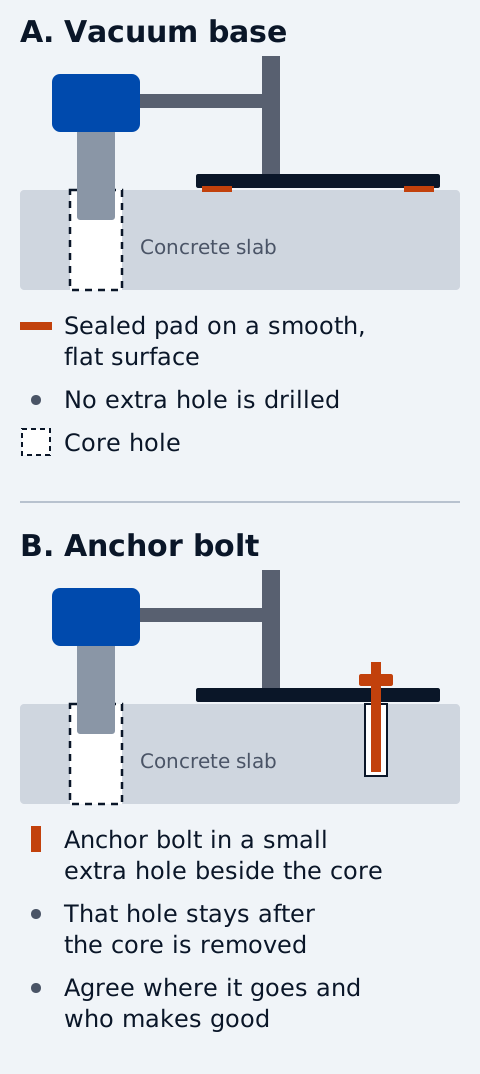
A core drilling rig is held down by a vacuum base sealed onto a smooth surface, or by an anchor bolt set in a small hole drilled near the core. Manufacturer manuals restrict vacuum fixing on walls, ceilings, tiles, coatings and rough concrete, so a finished surface may get a fixing hole. Agree it before the crew arrives.
- We fix our rigs with vacuum pads or mechanical bolts, as our core drilling service page states.
- A vacuum base leaves no hole, but the manuals want a smooth surface that seals, and limit it on walls, overhead, tiles and coatings.
- An anchor bolt needs its own small hole, set away from the core, so it stays after the core comes out.
- The manuals do not fully agree. The crew follows the manual for the rig on site; the engineer decides on extra holes in structural elements.
- Tell us the finish, which side is finished and where a fixing hole may go when you ask for a quotation.
How is a core drilling rig held in place?
A rig-mounted core drill is a motor on a column with a base plate. The base must stay still while the bit cuts. Hilti's DD 150-U instructions say: "Check that the drill stand is securely fastened to the work surface." There are two common ways:
- Vacuum base. A pump draws the air from under a sealed base plate, and air pressure holds the stand down. Nothing is drilled.
- Anchor bolt. A small hole is drilled near the core position, an anchor is set in it, and the base plate is bolted down. Husqvarna's DS150 and DS250 manual sets that hole at a fixed distance from the centre of the core, so it is still there when the core comes out.
The choice depends on the surface, the drilling direction and the rig manual. You do not need to choose; you need to answer the questions below before the job.
What do the manuals say about vacuum bases?
Five sources, quoted for what they say, not as fixing instructions:
- Milwaukee 3314 manual: "Do not secure to laminated surfaces such as tiles and composite coating." Never drill on the vacuum pad alone, except downwards.
- Hilti DD 150-U manual: "Rough surfaces may reduce holding power", and coatings may pull away. Horizontal drilling on the vacuum base needs an additional securing means; vacuum fixing overhead is prohibited.
- Husqvarna DS150 and DS250 manual (2023): "Do not use the product in combination with the vacuum plate when you drill in walls or ceilings."
- Concrete Sawing and Drilling Association (CSDA): its executive director Patrick O'Brien wrote that a vacuum base is not advised on rough or cracked surfaces, and "should never be used on a wall to secure a drill".
- RIDGID RB-214 and RB-215 manual: not recommended on rough or cracked floors, and not to be used on a wall.
The sources agree on floors: a vacuum base wants a smooth, sound surface that seals. They do not agree on walls. Hilti's manual describes horizontal vacuum drilling with an additional securing means; Husqvarna, the CSDA and RIDGID say no vacuum on a wall at all. We do not settle that here. The crew works to the manual for the rig on site.
What does this mean for tiles, marble, paint and epoxy?
Tiles are the clearest case: Milwaukee's manual names them. None of the manuals we read mentions marble by name. Treat a marble floor the way you would a tiled one: ask the crew how they plan to hold the rig, and do not assume a vacuum base will do.
Paint, plaster and epoxy are coatings, and Hilti's manual warns that coatings may pull away from the surface. On walls and ceilings most of the sources rule out the vacuum base, which usually leaves an anchor. So on a finished wall or ceiling, plan for a possible fixing hole in the finish near each core. Its size depends on the anchor, so ask for it with your quotation.
Should you core before or after the finishes go on?
Coring before tiling, painting or epoxy puts any fixing hole in bare concrete that the finish will cover. Ask the finishing trade whether they want it filled first.
When finishes are already in, we lay protection sheeting over finished floors, and for wet coring we fit a collar ring and a wet vacuum to contain the slurry. Hilti's manual makes a water collection system mandatory for wet drilling overhead; our concrete cutting safety guide covers water on site. For wet or dry coring in a finished room, see our post on AC and MEP openings in villas.
Is the anchor hole a structural question too?
It can be. An anchor hole is a second hole into the concrete. On a beam, column, transfer slab or post-tensioned slab, the engineer of record decides whether it is acceptable, as they do for the core itself.
If the core position is being scanned, ask for the scan to cover the fixing position too. We offer GPR scanning on request. A scan does not guarantee every object is found, so the engineer still reviews the positions.
Which question fits your surface?
A summary of the manuals, not a fixing method.
Swipe to see all columns
| Surface | What the manuals say about the vacuum base | Ask before the job |
|---|---|---|
| Bare, smooth concrete floor | Milwaukee: smooth, clean, non-porous surface. Husqvarna: flat and of good quality. | Vacuum or anchor? If an anchor, where does the hole go? |
| Tiled or marble floor | Milwaukee: do not secure to laminated surfaces such as tiles. No manual we read names marble. | Is a fixing hole through a tile acceptable, where, and who fills or replaces the tile? |
| Painted or plastered wall | Husqvarna, CSDA, RIDGID: no vacuum on walls. Hilti: additional securing means needed; coatings may pull away. | Where may the anchor hole go, and who makes good the paint or plaster? |
| Epoxy-coated floor | Milwaukee: do not secure to composite coating. Hilti: coatings may pull away. | Will the coating be marked at the fixing point, and who repairs it? |
| Rough or cracked concrete | CSDA and RIDGID: vacuum not advised. Hilti: rough surfaces may reduce holding power. | Is an anchor hole acceptable, and has the engineer seen the cracks? |
| Ceiling or soffit | Hilti: vacuum fixing overhead is prohibited. Husqvarna: no vacuum in ceilings. | Has the engineer accepted the anchor hole, is the slab post-tensioned, and how will water be collected? |
What to tell the crew when you ask for a quotation
This lets us plan the fixing before we arrive. The engineer and the rig manual still set the limits.
- The finish at each core position: bare concrete, tiles, marble, paint, plaster or epoxy.
- Which side is finished, or whether both are.
- Whether a small fixing hole beside the core is acceptable, and where it may or may not go.
- Who fills the fixing hole or replaces the finish afterwards. Agree it in advance and write it down.
- The direction of each hole: floor, wall or ceiling.
- The element (slab, wall, beam or column), and whether the slab is post-tensioned.
- Whether you want a GPR scan of the core and fixing positions.
- Photos of each position, with something for scale.
Frequently asked questions
Does core drilling leave a hole besides the core?
It can. An anchor bolt sits in a small hole drilled a set distance from the core, so that hole remains after the core is removed. A vacuum base leaves no hole, but the manuals limit where it can be used.
Can a vacuum base be used on tiles?
Milwaukee's 3314 manual says not to secure the vacuum pad to laminated surfaces such as tiles and composite coating. Ask the crew how they plan to fix the rig on your floor.
Can a core drill be fixed to a wall or ceiling with a vacuum base?
The manuals differ. Husqvarna's DS150 and DS250 manual and the CSDA article say not to use vacuum on walls. Hilti's DD 150-U manual requires an additional securing means for horizontal drilling on the vacuum base and prohibits vacuum fixing overhead. The crew follows the manual for the rig on site.
Who fills the fixing hole afterwards?
Agree it before the job. Write down whether a fixing hole is acceptable, where it may go, and which trade fills it or replaces the finish.
Should the anchor hole be scanned too?
Ask for the GPR scan to cover the fixing position as well as the core. On structural elements and post-tensioned slabs, the engineer of record decides whether the extra hole is acceptable.
Planning core holes through a finished floor, wall or ceiling?
Send the location, the finish type and photos of each position through our contact page, or call +974 7066 1660 or +974 5077 6363. You can also email sales@smartcutqa.com.
Send the location and photos for a quotation Call +974 7066 1660 WhatsApp the photos
Sources
- Hilti, DD 150-U core drilling system operating instructions (sections 2.1, 5.3.1, 6; copy hosted by a tool rental service)
- Husqvarna, DS150 and DS250 drill stand operator's manual (1341-005, 28 September 2023)
- Milwaukee, 3314 core drill user manual
- Patrick O'Brien, Concrete Sawing and Drilling Association, Dynamics of Diamond Core Drilling, National Precast Concrete Association, 22 May 2010
- RIDGID, RB-214 and RB-215 core drilling machine manual, page 8 (third-party manual host)
- Aseel Constructions, Core drilling service and GPR scanning service
All accessed 3 November 2026.