
Controlled demolition, explained
Cut it free first. Break it last.
Most concrete can come out without hours of jackhammer work. Cut the piece free with diamond saws or a line of overlapping cores, then split it, crush it or lift it out in sections. Any breaker work at the end is short. The right method depends on thickness, access, what sits below and how close the neighbours are.
- Saw or core the removal line first. A clean cut stops cracks running into the concrete that stays.
- Hydraulic splitters and crushers break concrete by pressure, not impact, so they vibrate far less than a hand breaker.
- On very thick sections, wire sawing is often faster than breaking.
- The structural engineer sets the removal limits and any temporary support before cutting starts.
- Ask for a GPR scan before cutting. We recommend it on post-tensioned slabs.
Why avoid long jackhammer work in occupied buildings?
A hand breaker works by repeated impact. That impact travels through the structure, so people on other floors hear it and feel it. It throws dust and chips across the room, and it can crack concrete past the line you meant to stop at.
In Qatar a lot of this work happens in buildings that stay open: a mall unit under fit-out, a hotel floor being refurbished, a hospital wing, a villa with neighbours on both sides, a tower with finished floors below. Tenants and patients carry on while the crew works.
The UK Health and Safety Executive (HSE) lists alternatives to hand breaking: machine-mounted hydraulic breakers, floor saws, hydraulic crushers and bursters, diamond core drilling, diamond wire cutting and hydro-demolition. It also tells designers to cast in ducts and detail box-outs so less breaking is needed later.
What are the main methods?
Most jobs combine two or three of these methods. Our controlled demolition service picks the mix after reviewing the drawings and the site.
Diamond saw cutting to isolate the zone
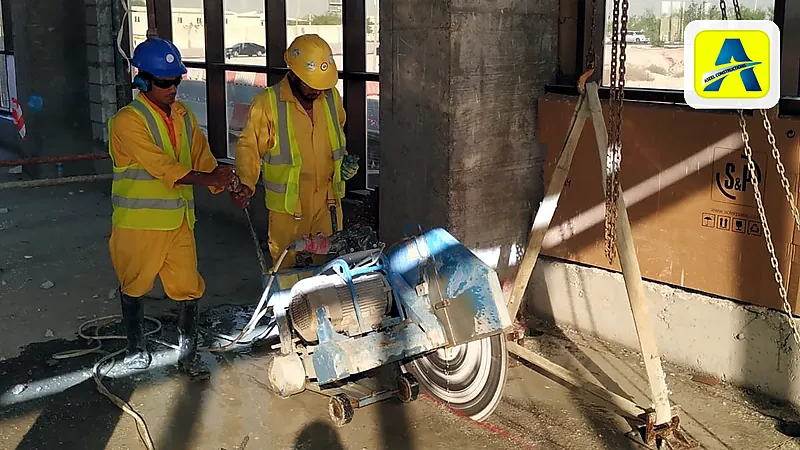
A diamond saw cuts the boundary of the removal area before anything is broken. A wall saw runs on a track for walls and soffits. A floor saw cuts slabs and paving from above. A diamond wire saw loops around sections too thick or awkward for a blade.
Concrete outside the line stays intact, and the piece inside can be sliced into blocks small enough to lift out. Our guide to choosing a concrete cutting method compares blade and wire in more detail.
Stitch drilling where a saw cannot reach
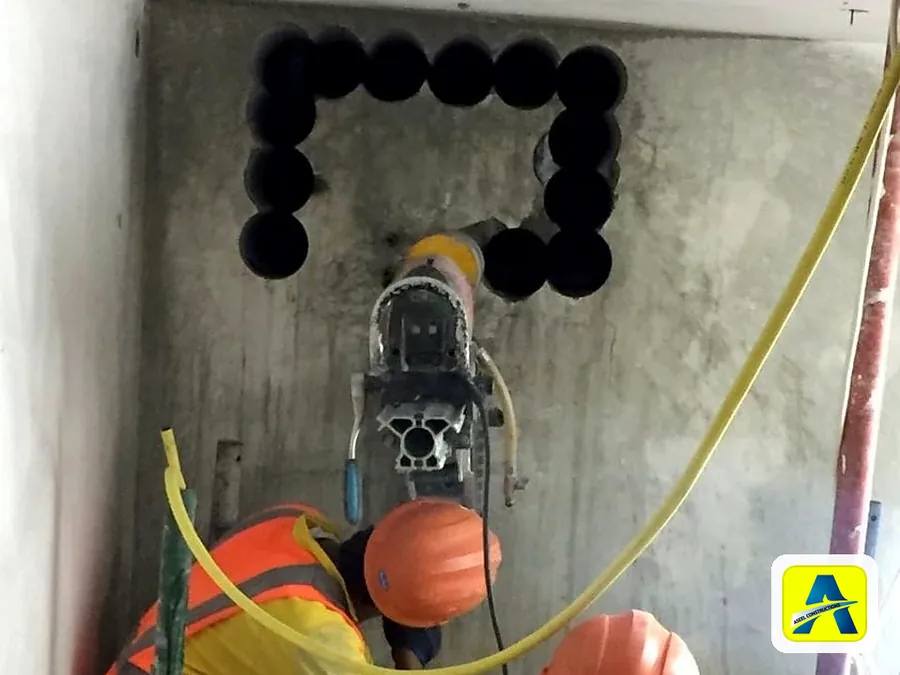
Stitch drilling means coring a line of overlapping holes along the removal boundary. When the cores join, the section is free. It suits tight corners, curves and spots where a saw track cannot be fixed.
One HSE case study describes a 15 m wall in a hospital maternity block refurbishment. The crew cut it free by drilling lines of overlapping holes with a diamond drill held in a clamp, then crushed it. With the drill clamped, the operator is not holding a vibrating tool. Our concrete coring rigs are anchored with vacuum pads or mechanical bolts, and we use overlapping cores to form larger openings.
Hydraulic splitting (bursting)
A hydraulic splitter breaks concrete from the inside. The crew drills a hole and inserts a wedge set. In the words of the Darda catalogue (published by Brokk), hydraulic pressure "pushes the wedge between the two counter wedges and presses them apart". Darda says a crack forms in seconds, without vibrations and with very little noise and dust.
The forces are large. Darda gives an effective splitting force of up to 4,048 kN (about 413 tonnes) for its C12 L model. Each splitter needs a matching hole:
- C2S N: 31 to 32 mm diameter, at least 270 mm deep.
- C9 N: 45 to 48 mm diameter, at least 410 mm deep.
- C12 N: 45 to 48 mm diameter, at least 610 mm deep.
Darda's listed uses include reinforced concrete, closed rooms and pile heads. For strong reinforcement, the standard counter wedges can be swapped for enlarging counter wedges. After expansion, Darda says, particularly strong reinforcement can be broken off easily.
An HSE case study on bursting covers a 1 m x 1 m retaining structure around a 300 m perimeter. Bursting was much quicker than the other low impact methods, and HSE noted that drilling the holes with a clamp-mounted diamond core drill could remove operator vibration altogether.
Hydraulic crushing
A concrete crusher grips the section between two jaws that close slowly. Nothing hammers. In the HSE hospital case the crusher was very quiet, the debris came away in larger pieces and there was less dust.
Crushers can be handheld or mounted on a remote-controlled demolition machine. Brokk says its crusher jaws pulverise material with few vibrations, and lists smaller machines of about 2,000 to 3,500 lb (roughly 900 to 1,600 kg) on a wide base for floors with low load limits. The floor still needs a load check first.
Wire sawing for very thick sections
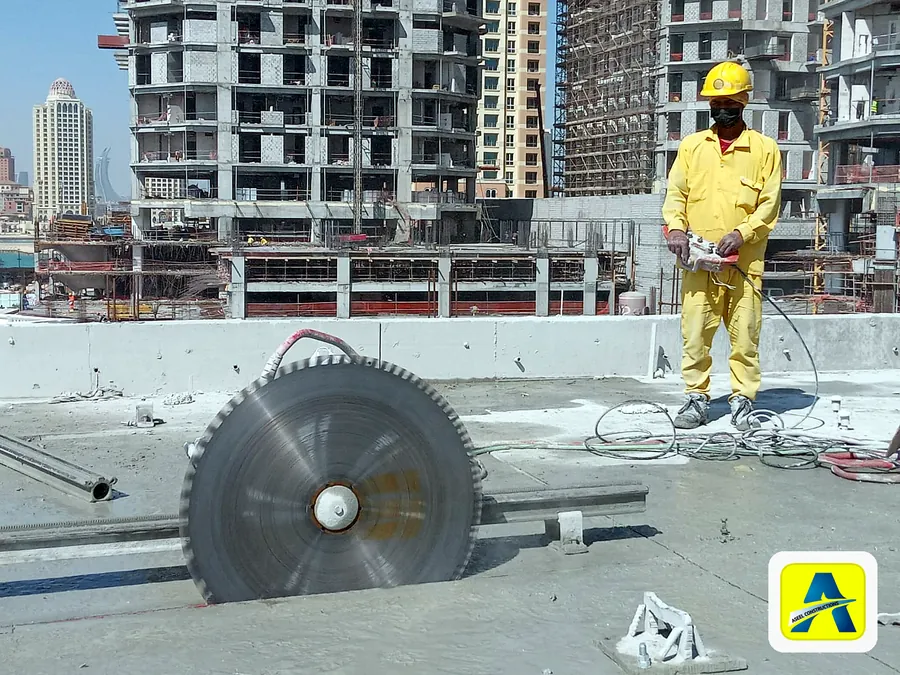
Thick foundations, plinths and slabs are slow going for breakers. A diamond wire passes through drilled holes, wraps around the section and cuts it in one continuous loop.
HSE describes a floor 1 m to 4 m thick above a 7 m wide tunnel, where a 3 m opening was needed. Hand breakers would have taken 40 to 60 worker days. The job took 3 days: a day and a half of diamond drilling, one day of wire sawing and two hours with an excavator-mounted breaker.
Where breakers still fit
Small volumes and edge trimming are often quickest with a breaker. We use electric breakers alongside hydraulic splitters and choose by access, thickness and how much vibration the building can take.
Which method fits which job?
A starting point only. The final choice comes from the drawings, the site visit and the engineer.
Swipe to see all columns
| Method | How it works | Best for | Noise and vibration | Dust and debris | What it needs |
|---|---|---|---|---|---|
| Diamond saw cutting | Blade cuts the boundary into blocks | Straight cuts in walls, slabs, paving | Low vibration, saw noise | Blocks lifted out; wet slurry | Water, power, room for the saw |
| Stitch drilling | Overlapping cores along the line | Corners, curves, no saw access | Low, with a clamped rig | Cores and slurry | Water, rig fixing, time |
| Hydraulic splitting | Wedges push apart in drilled holes | Mass concrete, pile heads, closed rooms | Very little; no impact | Very little dust; large pieces | Correct holes, power pack |
| Hydraulic crushing | Jaws close slowly | Walls and slabs already cut free | Very low noise | Less dust; larger pieces | Access; floor load check |
| Diamond wire sawing | Wire loop cuts the whole section | Very thick sections | Low vibration | Large blocks; slurry | Holes, water, pulleys, lift plan |
| Breaker | Repeated impact | Small volumes, edge trimming | High | More dust; small rubble | Dust control, protection |
What should you send us?
- Structural drawings with the removal limits marked.
- Concrete thickness, and whether it is confirmed or estimated.
- Floor level and the route for lifting or carrying pieces out.
- What is below and next to the work area.
- Working hours the building allows, including night shifts.
- Whether you want a GPR scan.
What has to happen before any cutting?
The structural engineer decides what can be removed and whether temporary propping is needed, and that happens before any saw or splitter reaches site. We confirm the boundaries with the engineer or main contractor and work to them.
Next, find out what is inside the concrete. A GPR scan maps rebar, post-tension cables and embedded services through the removal zone. We offer it on request and recommend it on post-tensioned slabs. Our post on GPR scanning before coring explains what a scan can and cannot show.
Then plan the debris: where each piece goes, how it gets there, and what the floor and lifting gear can carry. Size the blocks to suit the lift and the route. For dust and other site precautions, see our concrete cutting safety checklist.
How does Aseel handle controlled demolition?
We start with the structural drawings, reviewed with the engineer or main contractor, to confirm the removal boundaries and any temporary propping. GPR scanning follows if you ask for it. Where precision matters, we cut the boundary with a diamond wall saw or floor saw so the edge is clean and cracking stays inside the removal area.
We then break the concrete with electric breakers, hydraulic splitters or wire sawing, depending on access, thickness and how sensitive the building is to vibration. Rubble and steel are collected, segregated if the project requires it, and removed. Wet methods, dust suppression and containment sheeting keep dust and slurry inside the work area.
The full scope is on our concrete demolition page.
Frequently asked questions
Can concrete be removed with no vibration at all?
Some vibration is always possible. Sawing, coring, splitting and crushing produce far less of it than a breaker, and a planned combination keeps it low. Tell us what is next to the work area so we can plan around it.
Can hydraulic splitting handle reinforced concrete?
The Darda catalogue lists reinforced concrete among its uses. For strong reinforcement it offers enlarging counter wedges, and says the bars can then be broken off easily. The structural engineer decides what can be removed and how the remaining structure is supported.
Is sawing slower than breaking?
Not on thick concrete. In one HSE case study, a 3 m opening in a floor 1 m to 4 m thick took 3 days with drilling and wire sawing. Hand breakers would have needed 40 to 60 worker days.
Can you work at night or in an occupied building?
Yes. Our crews work in occupied buildings, confined spaces, high-rise floors and on night shifts. Tell us the working hours the building allows when you send the enquiry.
Do I need a GPR scan first?
We recommend one, especially on post-tensioned slabs, and we provide it on request.
What do you need to give me a quote?
Send the drawings with the removal limits, the concrete thickness, photos of the area and the access route, the allowed working hours and whether you want GPR scanning. We then agree the cutting sequence and removal scope with your project team.
Planning a removal?
Send your drawings and photos for a quote. Call +974 7066 1660 or +974 5077 6363, or email sales@smartcutqa.com.
Request a quote Call +974 7066 1660
Sources
- UK Health and Safety Executive (HSE), Hand-arm vibration good practice: alternatives to breaking
- HSE case studies on crushing concrete, bursting concrete and diamond wire cutting
- Brokk, Darda splitter catalogue
- Brokk, Brokk 101
- Aseel Constructions, Concrete demolition service
All accessed 24 October 2026.